
Planning a Kitesurfing Trip to Tarifa: Flights, Transport, Forecast, and the Week Around It
AT A GLANCE
The easiest way to plan your Tarifa kitesurfing trip is to fly into Málaga, rent a car, and drive about two hours to Tarifa. You can stay in the historic old town or closer to Valdevaqueros, the main spot for lessons. Every evening, check Windguru for the forecast, keeping in mind that the Levante wind usually blows stronger than predicted, and the Poniente often gets a thermal boost in the early afternoon. On a typical seven-day trip, you can expect to get four to six days of good kiting.
Most travelers plan a kitesurfing trip to Tarifa the way they plan a week anywhere else. Flights, hotel, a calendar of activities by day.
The pueblo at the end of the drive does something different with that calendar. It reshuffles it.
The reason is the geography: a fourteen-kilometer gap between Spain and Morocco funnels Atlantic wind into the Mediterranean, and the result is roughly three hundred windy days a year.
The trip sets up the same way. The list looks long at the start, and most of it sorts itself once the decisions come in the right order.
This guide walks you through what to sort before the wheels go up:
✔ Which airport makes sense
✔ Why a car is part of the plan
✔ Where to sleep
✔ How to read the wind
✔ What to pack
✔ What the days around the sessions look like
If you're still deciding if Tarifa is the right choice, our guide on whether Tarifa is beginner-friendly for kitesurfing addresses that question. If your travel dates are in April, May, or June, what to expect from spring in Tarifa offers more details about that specific season.
Planning a September trip? Our guide to learning kitesurfing or wingfoiling in Tarifa in September covers wind conditions, beach crowds, accommodation costs and how to plan your lessons.
Which airport should you fly into for a Tarifa kitesurfing trip?
Choosing the right airport for a kitesurfing trip to Tarifa depends on your departure location.
Málaga (AGP) is the top choice for most international travelers.
-
Pros: Widest international network, best fares, largest rental car selection.
-
Distance/Time: Approx. two hours via the A-7 coastal highway (through Marbella and Estepona).
-
Why it's the default: It offers the most connections, often resulting in the shortest total travel time, even if you need a connecting flight.
Gibraltar (GIB) is ideal for travelers from the United Kingdom.
-
Pros: Closest airport, quick in-and-out process.
-
Distance/Time: Approx. forty-five minutes by car.
-
Consideration: The border crossing into Spain is variable, potentially adding up to 40 minutes on busy weekends.
Jerez (XRY) is the quieter alternative, particularly for those connecting through Madrid or Barcelona.
-
Pros: Calm airport, direct drive through Cádiz province, avoids the heavy Málaga coastal traffic. Works well with Iberia and Vueling European routes.
-
Distance/Time: Two to two-and-a-half hours.
Sevilla (SVQ) can be an option if flight schedules or fares are favorable.
-
Distance/Time: About two-and-a-half hours.
-
Recommendation: Not the primary choice, but worth checking when booking.
Practical Tip: If your home airport offers a direct flight to any of these locations, take it. Otherwise, Málaga generally provides the shortest overall journey time due to its extensive connection network.
| Airport | Drive to Tarifa | Best for |
|---|---|---|
| Gibraltar (GIB) | ~45 min | UK travelers, short stays, small-airport convenience |
| Málaga (AGP) | ~2 h | Most international travelers, best route network and fares |
| Jerez (XRY) | 2 – 2 h 30 | Madrid, Barcelona, selected European routes |
| Sevilla (SVQ) | ~2 h 30 | Alternative when a specific route or fare fits |
Do you need a car for a Tarifa kitesurfing trip?
Yes, and It’s the one decision that makes the rest of the trip easier. Valdevaqueros is about fifteen minutes by car from the old town, there is no public bus between the two, and most of your week (beach, pueblo, day trips, days-off) depends on having your own wheels.
The beach is only fifteen minutes from the old town. Valdevaqueros, where our Pro Center is, has no public bus connecting it to the pueblo. Taxis, rental cars, and shared rides from hostels are how riders move around.
From 16 June to 16 September, Los Lances is closed to kiters. Los Lances is the long beach that fronts the pueblo and becomes a swim-and-sunbathe zone during those three summer months. Valdevaqueros is where the kiting happens. If your dates fall in that window, renting a car is non-negotiable.
Rental pick-up works smoothly at all three airports. Málaga has the largest fleet and the most competitive pricing. Jerez is quieter and quicker. Gibraltar is fast on the way out but the border can add time on the return.
Parking is easy outside the old walls. Inside Tarifa, old-town parking is paid and tight in high season, so most travelers leave the car outside and walk in. At Valdevaqueros, parking is straightforward.
The drive is a pleasant and easy experience, even if you are not used to driving internationally. The route from Málaga is entirely via highway, with signage in both Spanish and English. The last section, along the Strait, is a particularly scenic drive and a worthwhile part of the journey through southern Spain.
Where to stay: old town or Valdevaqueros?
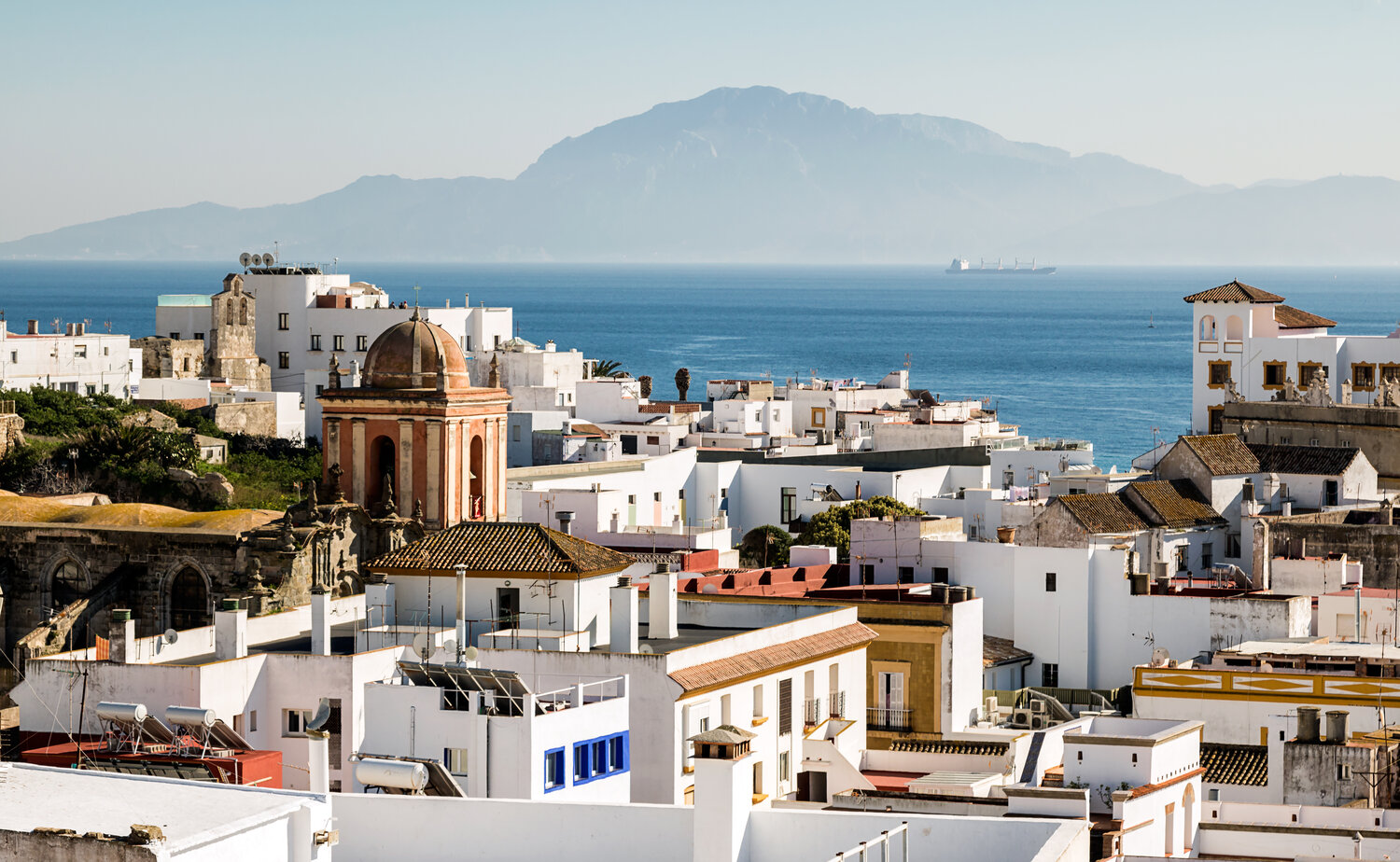
Tarifa offers two main accommodation options for travelers. The old town, located fifteen minutes from the beach, is ideal for those on mixed trips or traveling with non-kiting companions. In contrast, Valdevaqueros, situated only four hundred meters from the water, is better suited for kite-focused stays where proximity to the water is more important than dining options.
The old town puts you right in the heart of the town. You wake up inside thirteenth-century walls, walk to a coffee shop, and spend the non-kite hours between tapas bars, the Castillo de Guzmán, and the viewpoint over the Strait. For travelers splitting the trip between kitesurfing and everything else, or arriving with a partner who is not in the water, the Old Town is the natural base.
At Valdevaqueros, the spot is right at your doorstep. Campsites, bungalows, and small hotels line the coast heading northwest from town, inside the Parque Natural del Estrecho. The Hurricane area, just behind the dune, is where most riders who sleep at the beach end up. If your trip is mainly for kitesurfing and your rest hours belong to reading on the sand or a sunset drink at the chiringuito, sleeping near the beach removes the drive from your day.
Bolonia sits about twenty-five minutes farther along the coast. It is quieter than both options, closer to the Roman ruins at Baelo Claudia, and a reasonable base for longer trips where you want a mix of kite days at Valdevaqueros and slow days at the dune. Not the first pick for a short first visit.
| Base | Distance to Valdevaqueros | Best for |
|---|---|---|
| Old town (casco) | ~15 min drive | Mixed trips, non-kiting companions, tapas and culture |
| Valdevaqueros / Hurricane area | 5 min drive or 400 m walk | Kite-first trips, travelers with their own gear |
| Bolonia | ~25 min drive | Longer stays, quieter pace, access to Baelo Claudia |
How the wind sets the week
The wind decides which mornings are on the water and which are off. A well-timed seven-day window typically yields four to six usable kite days, and the rest of the trip rotates around them.
Two moments matter: a quick check before you book the dates, and a closer read the night before each session.
Two local winds do most of the work. Levante funnels east through the Strait and often overshoots the forecast by several knots. Poniente comes off the Atlantic from the west, cooler and more forgiving, and often kicks in thermal: a morning at five knots can become a fourteen-to-twenty-knot afternoon.
If you're coming to Tarifa to learn, these two winds can create very different conditions on the water. Our guide to Levante vs Poniente for Kitesurf Lessons in Tarifa explains how each affects kite control, gusts, waves and the exercises you'll practise as a beginner.
That rhythm is why we read the next forty-eight hours each morning, not the full week in advance. Floor, who runs the center, puts it simply:
"You look at three things. Is there any wind? Is it in the right direction? Is there sun? If yes, come to the beach and wait. The wind is coming." — Floor, Center Manager, Liam Whaley Pro Center.
Feel free to message us on WhatsApp if you have any questions about the forecast or how to read it.
Planning your trip dates? See which kitesurfing events may happen during your stay in our guide to kitesurfing events in Tarifa.
What to pack for Tarifa (and what the school already has)
Pack as if you are going on holiday, not on a gear-heavy kite trip. The school provides the full kit for lessons and rentals. What you bring is personal: sun protection, a passport, and a short list of small items.
Pack light. The school has the rest.
We provide the complete setup for lessons and rentals:
-
Kite, bar, and lines
-
Board
-
Harness
-
Helmet
-
Impact vest
-
Wetsuit sized to the week
What you bring is personal. Sunscreen that holds up during long sessions, plus a rash guard or thin long-sleeve for warmer months. Sunglasses with a retainer strap, because the wind finds them eventually. Booties if you use them. Passport, EU health card if applicable, and any personal medication.
Your wetsuit thickness gets sized to the week. Spring and autumn water runs cool enough to need 4/3 mm. Peak summer, from late July through early September, warms up to around twenty-two degrees, and a shorty or 3/2 is enough. The school sizes your wetsuit when you arrive, not months in advance.
For independent kitesurfers, bringing your own gear involves different considerations. While traveling with your own kite, you face potential luggage fees and the risk of damage during transit. Furthermore, the setup you pack may not be ideal for the specific wind conditions encountered at the beach that week. It's common for riders to carry an extra kite that ultimately remains unused.
Renting gear offers the advantage of always having the right kite for the current conditions (something that changes hour by hour in Tarifa). For instance, your personal nine-metre Rebel might be perfect for an 22-knot Poniente at home, but entirely unsuitable for a thirty-five-knot Levante two days later. With a rental, you get access to the full range, typically three to fifteen square metres, ensuring you can ride whatever the day demands. An added benefit is flying home with lighter luggage.
For information about gear, please check out the kitesurf rental page. Feel free to contact the center on WhatsApp for advice on the right equipment sizes for your planned dates.
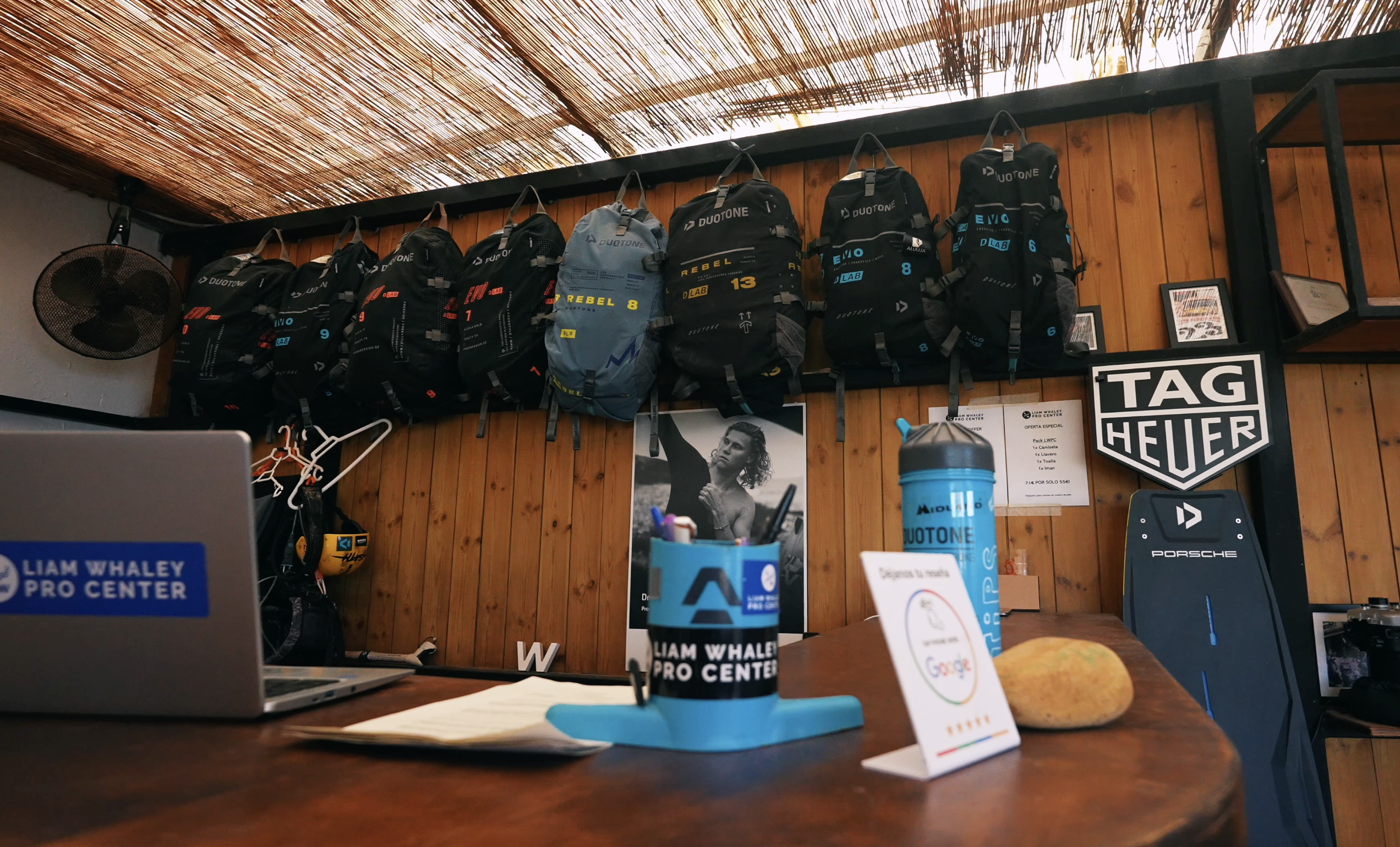
What do you do between kite sessions in Tarifa?
Between kite sessions, the week fills with time in the old-town and day-trips across the Strait. Some days the wind holds from eleven to sunset, others it sleeps until afternoon, so the hours off the water are part of the trip.
Some options depend on the wind, some others not. The old town inside its thirteenth-century Moorish walls works every day: tapas, coffee, and the Castillo de Guzmán. Behind the pueblo, the Parque Natural del Estrecho fills the gaps in your forecast.
Whale trips from Tarifa harbour need calm conditions, since strong wind cancels the boats, but the payoff is seven cetacean species in the Strait and orcas following the bluefin tuna migration in July and August. Bolonia and the Roman ruins at Baelo Claudia, twenty-five minutes north, are the classic low-wind day. A ferry to Tangier, about an hour across the water, takes a full morning free of sessions.
Your partner, friend, or family member who is not getting in the water still has a full week of their own.
Most of these options run independently of the wind, so non-kiting days become shared days rather than time spent waiting.
⤷ In our What to do in Tarifa beyond kitesurfing guide you’ll find each option broken down — operators, timing, and how to match no-wind mornings to your forecast window.
By day three, the logistics that felt heavy before the flight feel natural. The car is parked outside the walls, the wetsuit is drying on the line, and Windguru is open in the background without drama.
What carries the week isn’t the plan you arrived with. It’s the rhythm you pick up.
Liam says it like this:
"Tarifa teaches at its own pace. If you come for a week, the wind decides what you take home. That is as true for a first-time student as it is for a world champion." — Liam Whaley, founder, Liam Whaley Pro Center.
⤷ Spring weeks, through April, May, and June, run balanced on wind and space on the beach. Those windows fill earlier than the others. If those are your dates, the kitesurfing lessons page has current availability, and WhatsApp is the fastest way to line up the week.
⤷ Check also our Tarifa in Spring for Kitesurfing: What to Expect in April, May and June blog for more info.
Frequently asked questions about planning a kitesurfing trip to Tarifa
Do I need a car in Tarifa? +
Yes. Valdevaqueros is about fifteen minutes by car from the old town, and there is no public bus between the two. A rental picked up at Málaga, Jerez, or Gibraltar covers the trip.
Full detail in the section on whether you need a car.
Which airport should I fly into? +
Málaga is the default for most international travelers because of the widest route network and the most competitive fares, about two hours by car. Gibraltar is closer at forty-five minutes but has fewer routes, and Jerez works well for Madrid, Barcelona, and some European connections.
Full detail in the section on which airport to fly into.
What tool does the team use for the wind forecast? +
Windguru. We read the night before and again in the morning. Levante usually overshoots the forecast by several knots, and Poniente often kicks in thermal by early afternoon.
Full detail in the section on how the wind sets the week.
What do I need to bring, and what does the school provide? +
The school provides the complete kite setup, helmet, impact vest, and wetsuit sized to the week. You bring personal items: sunscreen, sunglasses with a strap, a rash guard, booties if you use them, passport, EU health card, and any medication.
Full detail in the section on what to pack.
What is there to do on days without wind? +
Whale and dolphin watching from Tarifa harbour, the Roman ruins at Baelo Claudia in Bolonia, a ferry day trip to Tangier, hikes in the Parque Natural del Estrecho, or a slow morning around the old town and the Castillo de Guzmán. A kitesurfing trip to Tarifa rotates between kite days and everything else.
Full detail in the section on what to do between kite sessions.
Latest News
- Levante vs Poniente for Wingfoil Lessons in Tarifa
- Levante vs Poniente for Kitesurf Lessons in Tarifa
- Is September a Good Month to Learn Kitesurfing or Wingfoiling in Tarifa?
- Am I Ready to Rent Kitesurfing Gear in Tarifa? (Or Do I Need More Lessons?)
- Wingfoiling for Kids in Tarifa: What Parents Should Know Before Booking
- Kitesurfing or Wingfoiling for Kids in Tarifa: Which Should They Try First?
- What Will You Learn in Wingfoil Lessons in Tarifa? From Day One to Independent Riding
- Is Tarifa a Good Place to Learn Wingfoiling? What We Tell Beginners Before They Book
- What Happens in Your First Wingfoil Lesson in Tarifa? We Get Asked This a Lot
- Am I Too Old to Learn Kitesurfing at 50 or 60 in Tarifa?