
Is Tarifa a Good Place for Kids to Learn Kitesurfing? Age, Safety and What Parents Should Know
Most kids who learn to kitesurf at our kiteschool in Tarifa start around 12. What actually decides it is whether your child is comfortable in deep water, and whether they weigh enough to hold down the smallest kite we fly in Tarifa's wind.
Tarifa is a good place for a kid to learn, but for the right kid (personality, weight, age) and on the right day.
It's also fair to say Tarifa isn't the easiest spot in Europe. Deep water, days of Levante past 30 knots, a busy beach in summer. None of that rules children out, but it's worth knowing what you're booking into. Everything below is the stuff parents ask us before they come.
Send us a WhatsApp if you'd rather talk it through, or skip the reading and book your kid's kitesurfing lessons directly.
Is Tarifa a good place for kids to learn kitesurfing?
A few things about the spot itself for your kid
The wind is the reason people come here. It blows almost every day of the season, so a week usually gets you four to six days on the water instead of one lucky afternoon. That matters more than it sounds, because learning to kitesurf is repetition and repetition needs days.
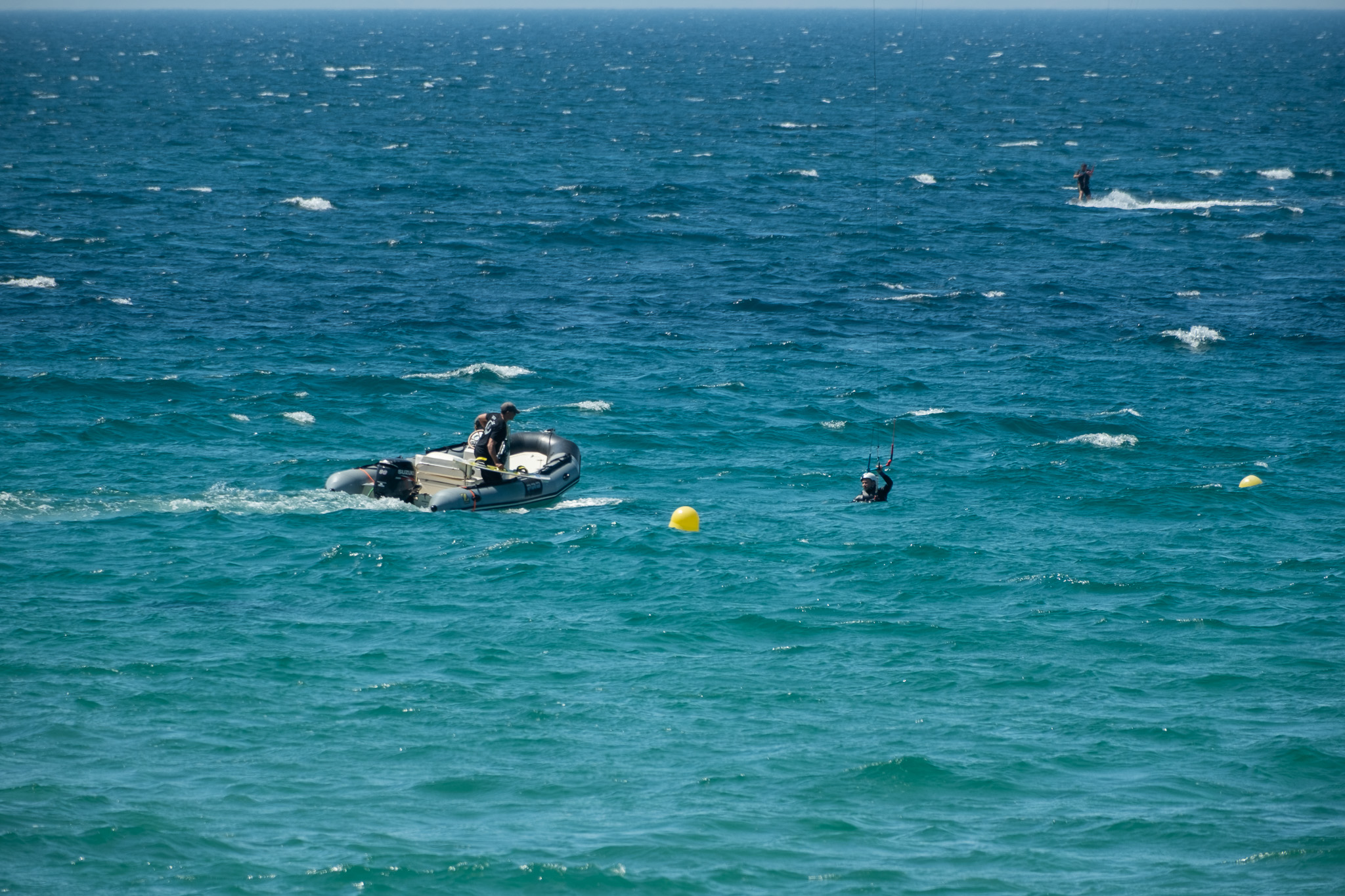
The water is the trade-off. Valdevaqueros drops off fast, so a kid can't put their feet down and reset when it goes wrong. That's why we keep a rescue boat over the teaching area the whole session.
There's also less beach than you'd think. About 25 to 50 metres of sand from the sea line to the fenced reserve, and our teaching zone runs 200 to 300 metres to the left of the center, away from swimmers and independent riders. In summer it's tight enough that lessons head into the water sooner.
Gear is the part that quietly matters most for kids. Kites from 3 to 15 square metres, lines from 10 to 24 metres, so there's always something small enough for a light rider on a strong day.
And some kids should wait. If yours can't swim comfortably, or panics with water over their head, this isn't the spot yet. Same if they're too light to hold down the smallest kite when the Levante is really on.
That goes for adults too. We cover more about beginner conditions in Tarifa and here: is Tarifa a beginner-friendly spot?
What age can a child start kitesurfing at Valdevaqueros?
Around 12, on average.
It isn't a cutoff in either direction. Some eleven-year-olds are ready and some fourteen-year-olds aren't. Age is a rough stand-in for the two things that actually decide it: body weight, and confidence in deep water.
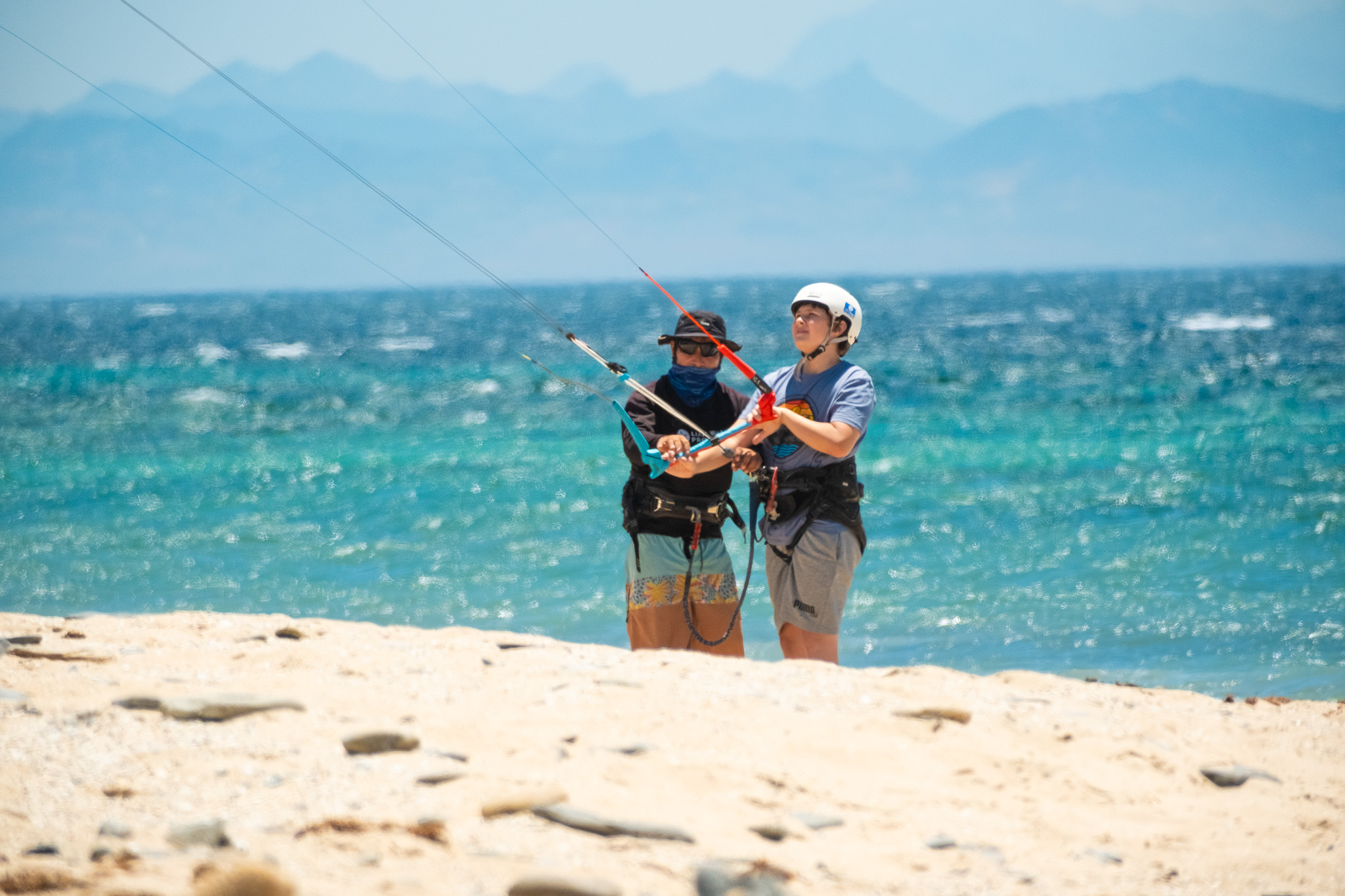
Worth mentioning, though, flying a kite (the first introduction or tester lesson) can happen much earlier. A younger kid can start on a trainer kite years earlier (8 or 9), and that's a proper fun way to introduce them to the sport and to spend outdoor time on the beach. They learn the wind window, how the kite reacts to their hands, and how to steer it without getting pulled anywhere. It's the same first skill every adult learns, just without the water and without the power.
So if your kid isn't there yet, they can still start. The trainer kite comes first, the deep water comes later.
Why body weight matters as much as the birthday
The kite pulls through the harness, not the arms. The harness spreads that load across the body, and the bar is there to steer and to let power in and out. It isn't a strength sport.
Weight is what holds a rider in place when a gust comes through. Most kitesurf schools want a child at around 35 kg before starting proper lessons, and that number is about gusts, not muscle.
The smallest kite we have is 3 square metres, and on a 30-knot Levante day a 3 still carries real pull. A light child and a heavier one on the same beach, on the same afternoon, are working against different amounts of force.
So your child needs to be heavy enough for the wind that's actually blowing. The same child can be fine in a 15-knot Poniente and too light for a strong Levante three days later. That's why we assess on the day instead of giving you a fixed weight or age over email.
What "confident in the water" actually means here
Two things.
They can swim on their own, without thinking about it. And they stay calm when water goes over their head or the board drifts out of reach for a few seconds.
Valdevaqueros gets deep close to shore, and after the first lesson every session happens in water where a child can't stand. A pool and the open Atlantic at a windy beach are not the same thing.
Tell us where your child sits on both points when you book. It changes the kite size, the format, and where the lesson starts.
What's different about a kitesurfing lesson for a kid?
The sequence is the same one every beginner follows: kite control on land, then body dragging, board recovery, water starts, first rides. Same whether the student is twelve or forty. It's covered step by step in what happens in a first kitesurfing lesson and across the whole course in the beginner path from day one to independent riding.
What changes is how it gets taught. A kid's lesson is built to be fun first. Same drills, set up as games, because a kid who enjoyed the session comes back for the next one. Coming back is what gets them riding.
Five things are different in practice.
1. The format. Kids are almost always taught privately. Matteo: "If we have young kids, due to the strong condition and the deep water, we always try to offer a private tuition." One instructor, one child, no waiting on the beach while someone else takes their turn.
2. Kite size and the wind that works. A lighter rider needs a smaller kite. A day that's fine for an adult beginner can be too strong for a light child. It works the other way too: a 10 to 13 knot day that's frustrating for an adult can be a good session for a kid because they need less wind to get them going.
3. Pacing. Shorter explanations, more repetition, more breaks. Kids take one instruction at a time rather than a list, so we break it into smaller pieces and go back over it more often.
4. How close the instructor stays. Every student wears a radio helmet so the instructor can talk to them the whole session. With kids the instructor stays nearer and gets in the water with them until the kid is fully confident it can do it alone.
5. Learning kiting as a fun activity. Some kids need more talking, some need more doing, and the instructor reads that on the day. What stays the same is that the exercises get set up as games.
A few of the things we do with kids:
-
Starting on a trainer kite in light wind, which feels like flying a kite on the beach while it's teaching the wind window
-
Setting up an obstacle course on the sand and having them walk the kite through it, keeping it parked in the same spot the whole way
-
Calling out a position and having them put the kite there, then changing it, then changing it again
-
Flying the kite one-handed while walking over to pick the pump up off the sand
-
Letting them pump and rig their own kite instead of watching us do it
-
Towing them through the water on the instructor's harness while he flies the kite, so they feel the pull before they have to control it (they love this)
-
Once the body drag works, giving them targets: downwind, then across, then back upwind
All real steps in the course. They just don't feel like steps.
What doesn't change is the bar. A kid has to show the same skills as an adult before going out without an instructor.
How does the center keep children safe on the water?
Lessons happen in deep water, so everything is built around that.
There's a rescue boat sitting over the teaching area the whole session. It's there to grab a kid who's drifted, chase down a board, or step in before something turns into a long swim back. Thomas Kristensen brought his kids, 13 and 14, and put it better than we would: "The rescue boat team were critical to make it a safe learning environment."
Every student wears a helmet with a radio in it and a life jacket. The jacket does the work when they're tired, so they can float and sort out a line instead of treading water.
And you can watch the whole lesson from the beach. The teaching zone is close enough that you'll be able to see your child throughout the session, which can make those first-day nerves a little easier for both of you.
More on how sessions run is in our kitesurf lessons in Tarifa.
How long does it take a child to start riding?
Longer to get going. Much faster once they do.
Nobody's going to give you a number before meeting your kid, but the shape is pretty consistent. Kids need more sessions to reach the same point, mostly because their sessions are shorter in practice. Concentration runs out before the clock does. The general picture for everyone is in realistic learning timelines, and for a kid it stretches past that.
Then it clicks. Second lesson, third lesson, sometimes later, and there's no telling which kid it happens to early. But once it does they take off. Adults are still thinking it through, and kids just do it.
The slow part is everything before that. Body dragging and board recovery are where most of them sit for a while, and it's boring in a way lesson one isn't. That's the stretch where a kid either keeps going or quietly loses interest.
So come planning for kite control and body dragging. If the click happens while you're here, great. If not, a bit more every season until they're overtaking you.
What do parents need to sort out before the trip?
Not much, but a couple of things catch families out.
You'll need a car. There's no bus to Valdevaqueros and we don't run transport, so it's a rental or a taxi both ways every lesson day. About 15 minutes from town, free parking here.
Think about where you stay if you're coming in summer. Kiting is banned along Tarifa town's beaches from 16 June to 16 September, so don't book somewhere assuming you'll walk to the water.
If you can, check the forecast before coming to the school. Kids need a narrower band of wind than adults, so it's worth spreading lessons across the week rather than booking them back to back. How the forecast shapes your lessons explains what to look for.
And message us on WhatsApp before you book. There's a consent form for under-18s, but that's two minutes at registration.
Flights and accommodation are in the full trip-planning guide.
What does the rest of the family do while a child is in a lesson?
Nobody has to sit on the sand for two hours.
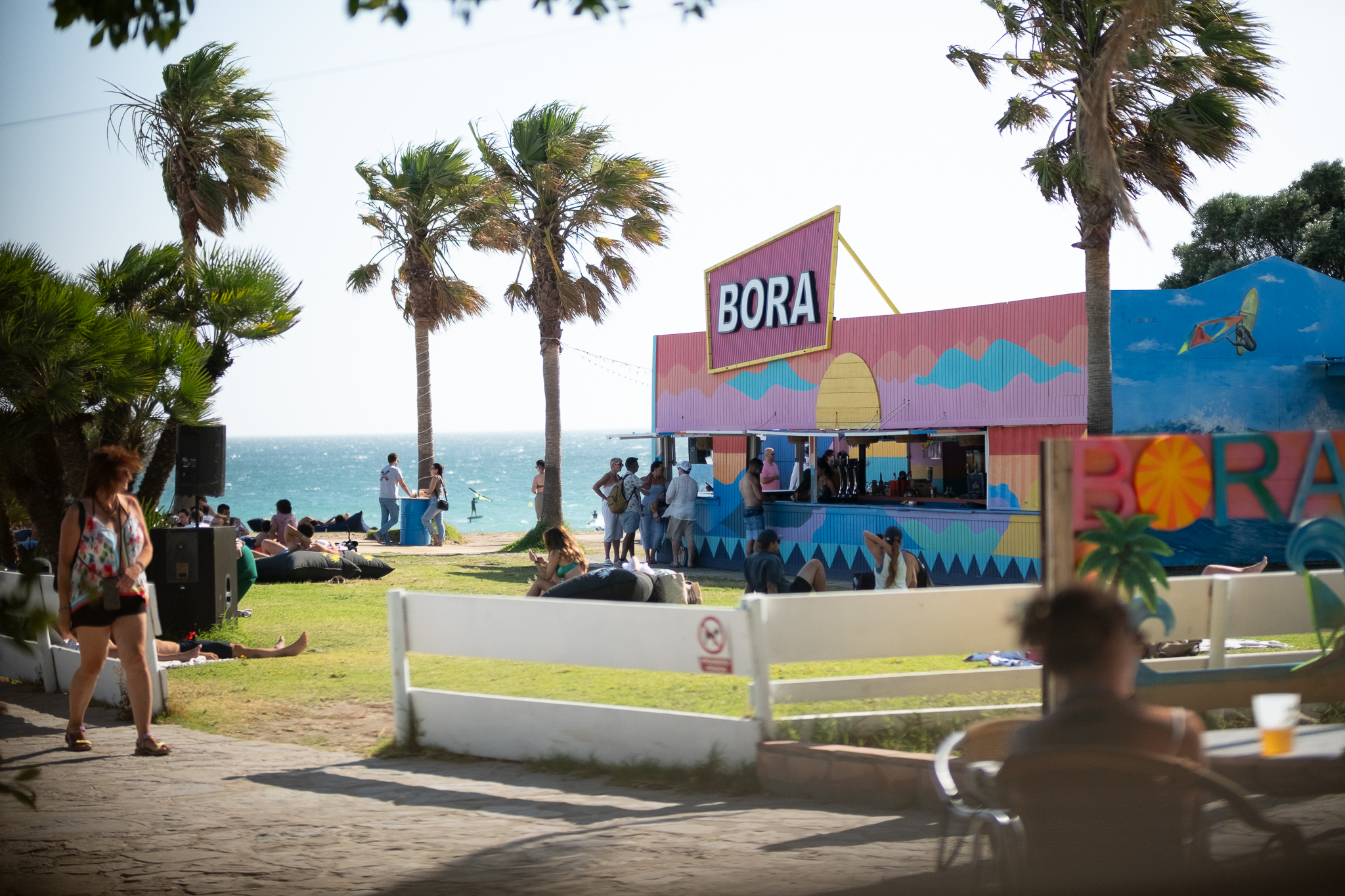
We have a reserved chill-out area, showers and changing rooms, and Bora sits right next door with food, drinks and live music through the afternoon. You can see the teaching zone from there, so you can watch without standing in the wind the whole time.
If someone would rather be on the water than beside it, it's the same beach and the same counter. Kite, wing and windsurf rental all run from here, and you can swap sizes or switch sport through the day instead of picking one in the morning.
Valdevaqueros takes up an afternoon on its own. The dunes are a walk to the right of the center, the beach runs on to natural pools at the far end, and the sunset over the sea line is why people stay late.
For no-wind days, Tarifa town is 15 minutes away and there's plenty around Valdevaqueros and Tarifa worth building a day around.
Can two kids take kitesurfing lessons together in Tarifa?
Yes for the first lesson. After that, separately.
Lesson one: together. It's on land. The wind window, the safety systems, flying the kite. Two kids do that together fine, and a size gap doesn't get in the way. We size the kite down to whatever the smaller child can hold, and since the kite only needs to fly rather than pull at this stage, that same small size works for the older one too. A twelve-year-old and a nine-year-old can share it without either getting a worse lesson.
The water phase: separate. From body dragging onward each child needs their own kite size and their own line length, and the instructor needs to be within reach of one student rather than watching two in deep water.
Can I learn to kitesurf with my kids at the same time?
You can start together. You won't progress together.
Lesson one: together. A parent and a kid, two siblings, or the whole family. Everyone flies a kite sized for the lightest person in the group, and since the kite only needs to fly at this stage, nobody loses out.
The water phase: private. From body dragging onward, two people sharing a kite need to be close in weight and close in level. A parent and a child usually aren't.
Say you want to learn as a family when you message and we'll build the week that way.
What happens to a child's kitesurfing lesson when Levante is blowing 30 knots?
Tarifa is known for strong wind, so this comes up a lot with kids' bookings.
If the lesson can run, it changes shape. The beach session gets cut short or skipped. Theory and safety systems still happen on the sand, then we go straight into the water with the instructor alongside. Matteo: "when wind's strong and sometimes gusty, we prefer to experience everything on the water. There is a bit safer." Kites drop toward 3 square metres and lines get shortened.
If it can't run, it moves. When the wind is too much for a child, we reschedule to the next suitable day. If there's no suitable day left in your trip, the lesson is refunded.
The call gets made that morning. Not at booking. Matteo: "the condition can be one day 12 knots and the guy can perfectly ride and with Levante not."
Light days work in your favour. Tarifa gets plenty of 10 to 13 knot days. Frustrating for an adult, excellent for a small kid. A light rider can have a full session on that wind and sometimes get to water starts. The days that would be a write-off on an adult's trip are often the best days of your child's.
That's the reason to book more days than lessons.
Frequently asked questions
What is the minimum age to learn kitesurfing in Tarifa? +
There isn't a fixed one. Most kids who learn here start around 12, but weight and water confidence decide it.
Does my child need to be able to swim? +
Yes. They need to swim on their own and stay calm with water over their head. After the first lesson, every session happens where a child can't stand.
What safety gear does a child wear? +
A helmet with a radio in it so the instructor can talk to them throughout, and a life jacket. A rescue boat covers the teaching area the whole session.
Can I watch my child's lesson from the beach? +
Yes. The teaching zone sits just to the left of the center, close enough in to see them the whole time.
Do I need to sign anything for a child under 18? +
Yes, a parent or guardian signs a consent form before the first lesson.
What happens if the wind is too strong on the day we booked? +
We reschedule to the next suitable day. If no suitable day is left in your trip, it's refunded.
Ready to book your child's first lesson in Tarifa?
Message us on WhatsApp before you book anything. Send your child's age, roughly what they weigh, how confident they are in deep water, and your travel dates.
That's enough for us to tell you whether your kid is ready, whether siblings can start together, and how to space the lessons across your week. You'll get a straight answer, including "not yet" if that's the honest one.
The rescue service is included rather than sold as a separate card. Kite sizes run from 3 to 15 square metres, so there's always something small enough for a light rider. We're at 4.82 out of 5 across 160 Google reviews.
When you're ready, book kitesurf lessons directly.
Latest News
- Is Tarifa a Good Place for Kids to Learn Kitesurfing? Age, Safety and What Parents Should Know
- Kitesurfing vs Wingfoiling: Which Should You Learn in Tarifa?
- Private, semi-private or group wingfoil lessons in Tarifa: which should you choose?
- How Fit Do You Need to Be to Learn Kitesurfing in Tarifa?
- How long does it take to learn kitesurfing in Tarifa?
- Beginner Kitesurfing Course in Tarifa: From Day One to Independent Riding
- How to Choose the Right Kitesurf Setup for the Day in Tarifa
- What Is Included in a Kitesurfing Lesson in Tarifa (and What to Bring)?
- Duotone Kite Demo Day in Tarifa: Testing the Latest Kites at Liam Whaley Pro Center
- Kitesurf Lesson Formats in Tarifa: Private, Semi-Private or Group?