
What Is Included in a Kitesurfing Lesson in Tarifa (and What to Bring)?
For your first lessons in Tarifa, you don’t need to bring anything. We sort all the gear from day one and fit you with the right gear: kite, board, bar, harness, wetsuit, and the safety kit.
And you won’t be choosing your own setup yet, which is actually a good thing. Your instructor matches everything to your level, the plan for the day, and what the wind’s doing, so all you have to think about is learning.
⤷ If you want an exact picture of what you’ll do during your first lesson, go and check out your first kitesurfing lesson in Tarifa. There we walk you through what to expect from beginning to end, and answer the questions most beginners have, like whether you’ll actually get on the water, what you’ll be doing, and so on.
⤷ Still deciding if Tarifa is the right place to start? Here’s why it’s such a beginner-friendly spot to learn.
⤷ Curious what a first session actually looks like? Watch actor Maxi Iglesias get on the water for the first time with the team.
Do beginners need to bring their own kitesurf gear to Tarifa?
No. For lessons with us, everything’s provided and fitted on the day, the kite, board, bar, harness, wetsuit, helmet, and a 50N buoyancy aid included.
Honestly, bringing your own gear this early tends to make things harder, not easier. The right setup shifts with the wind, your weight, your level, and whatever you’re working on that day.
And in Tarifa, the wind rarely sits still for long. Levante comes in from the east and can really crank in summer. Poniente blows from the west, usually softer, sometimes with a bit of swell. Things can flip in a couple of days, so the kite that was spot on for Monday might be the wrong call by Thursday.
A kite has to suit your weight, your level, the conditions, and where you’re at in the lesson. You’re not expected to read all that yet, that’s the instructor’s job. They’ll pull the right setup off the rack once they’ve had a proper look at the wind on the beach.
What should I bring to a kitesurf lesson in Tarifa?
Just the personal stuff that keeps you comfortable before and after. Leave the technical gear at home.
We kit you out with everything on the day, so you can travel light and turn up ready to go.
Bring:
-
Swimwear
-
Sunscreen and a hat
-
A towel and some water
-
Sunglasses for hanging on the beach
⤷ Still sorting out the trip side of things? Have a read of planning a kitesurfing trip to Tarifa.
What gear is included in your kitesurf lesson?
You’ll ride one kite and one board at a time, with the bar, harness, wetsuit, helmet, and buoyancy aid completing the setup. It can look like a lot at first, but each piece has one simple job, and once you get what each one does it stops feeling like a pile of separate parts and starts working as one connected system.
The kite
The kite is the engine. It’s what makes the power that lifts you up and pulls you along.
In the early lessons we’re after controlled power, not maximum power. So we’ll put you on a stable, forgiving kite on short lines while you get the hang of basic kite control.
Most first lessons run a Duotone Neo or a light one-strut kite on 10 to 12 metre lines. Shorter lines keep the kite calmer and easier to handle, and cut the chance of tangling lines with someone else, which matters on a busy day.
More kite means more pull. On day one, too much pull usually just creates tension, not skill.
Size still depends on the day. Strong wind, smaller kite. Light wind, bigger kite. Your instructor sizes it with you once they’ve read the wind on the beach.
The bar, lines and safety system
The bar is what you hold to steer and control the kite. It links to the kite through the lines, and it’s where the safety system lives, the thing you use to dump or release power.
When you steer with the bar, that input runs up the lines and moves the kite around the wind window. Push the bar away and you depower. Pull it in and the power comes on.
The safety release is your off switch. Fire it and the kite dumps most of its power, so you can kill the pull and reset without any drama.
Before you spend any real time on the water, your instructor walks you through how the bar works, how to power up and depower, how to use the safety release, and how to reset everything afterwards. The goal is simple: letting go of power should become second nature.
The harness
The harness takes the kite’s pull off your arms and spreads it across your body. It hooks to the bar through the chicken loop at your waist, so your core carries the load instead of your hands.
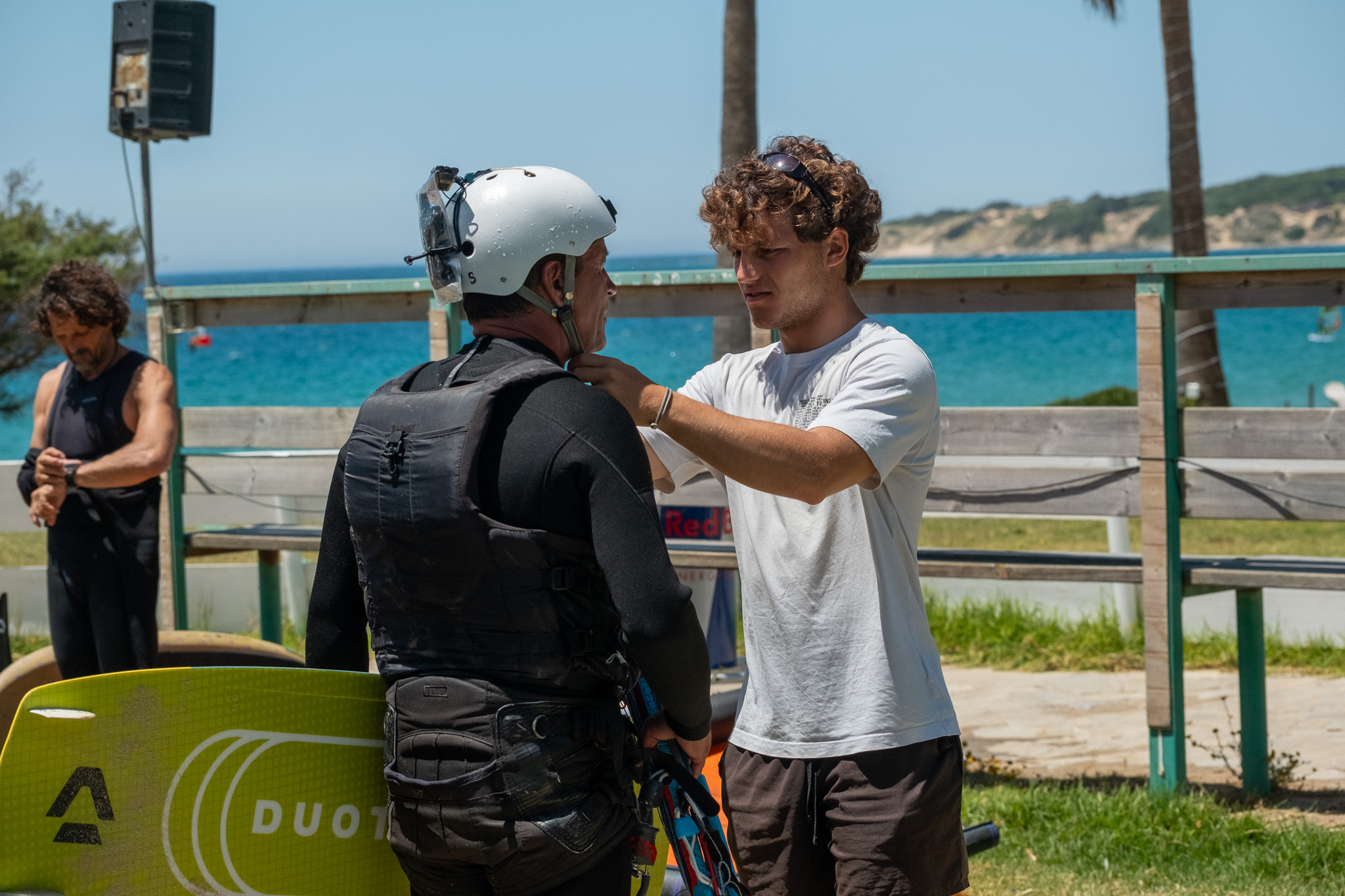
We’ll set you up with an ION waist or seat harness depending on your build, what’s comfortable, and the plan for the session. A seat harness sits lower and gives some beginners a bit more support.
Neither one is better, they just suit different people. A couple of minutes spent getting the fit right saves a lot of grief later on.
The board
Most beginners start on a twin tip, a symmetrical board you can ride both ways without switching your feet.
We use a bigger, stable beginner board to make those first rides easier. More surface area means you float better, get going sooner, and stay in control.
The board shows up later than most people expect. First you learn to fly the kite. Then comes body dragging, where the kite pulls you through the water with no board at all. Once you can make power on purpose, the board comes out.
It’s the last thing you pick up, not the first. And a bigger board makes those early attempts feel a lot more rewarding and a lot less frustrating.
The wetsuit, helmet and flotation
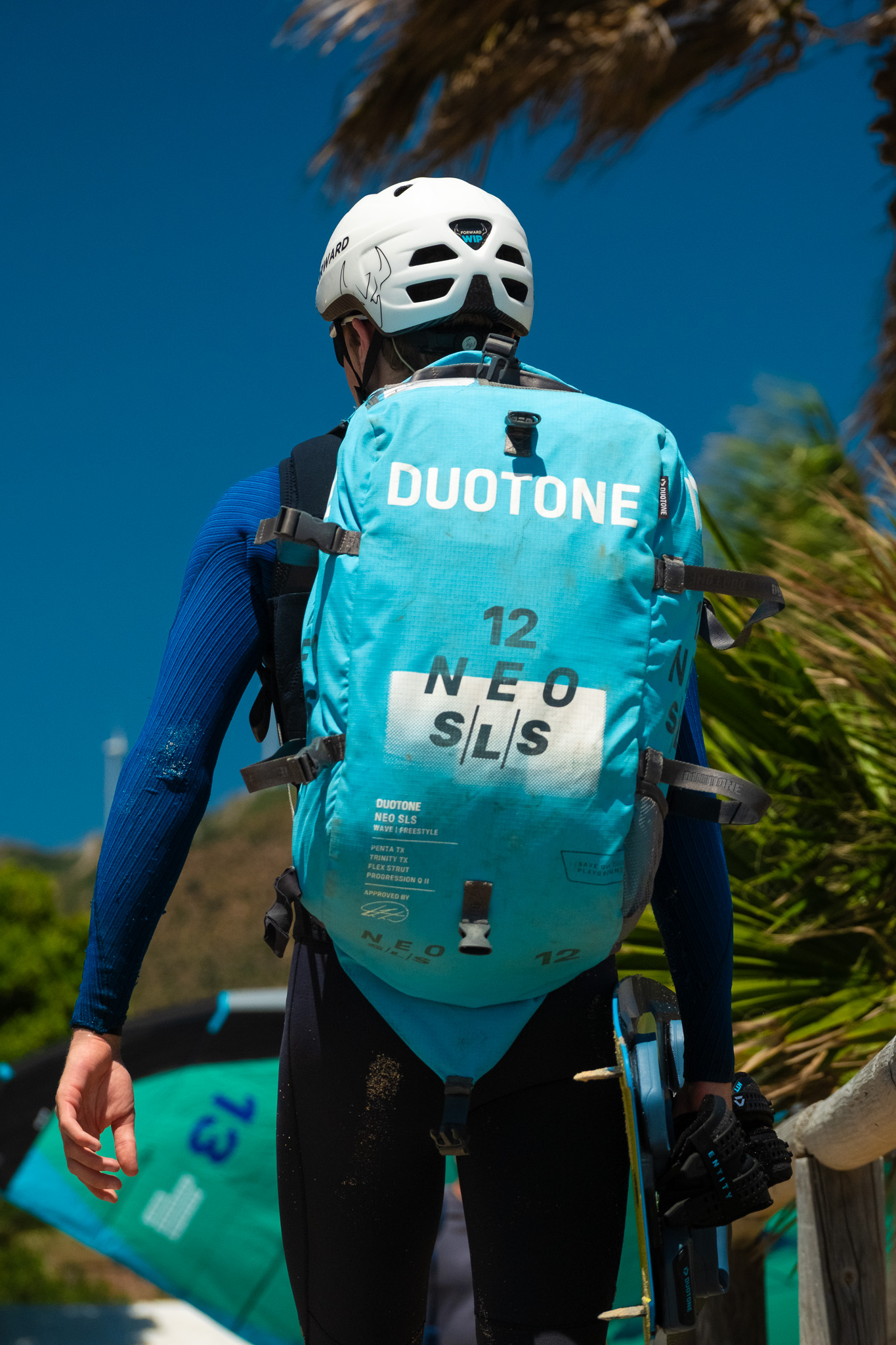
A wetsuit, helmet, and 50N buoyancy aid round off the kit. The wetsuit keeps you warm through a session full of stops, resets, and fresh attempts.
The helmet and buoyancy aid are standard on every lesson, you’re learning in moving water with a kite up overhead, so they’re non-negotiable.
Tarifa’s water runs cooler in winter and warmer in summer, so we pick the wetsuit thickness to match the day. Most of the time it’s a 4/3 or 3/2, depending on the season and the conditions. If you’re learning across the spring months from March to June, expect cooler water and a slightly thicker suit early on.
The helmet’s got a radio in it, so your instructor can talk you through each step from the beach while you’re out on the water. The buoyancy aid is a must on every lesson, no exceptions.
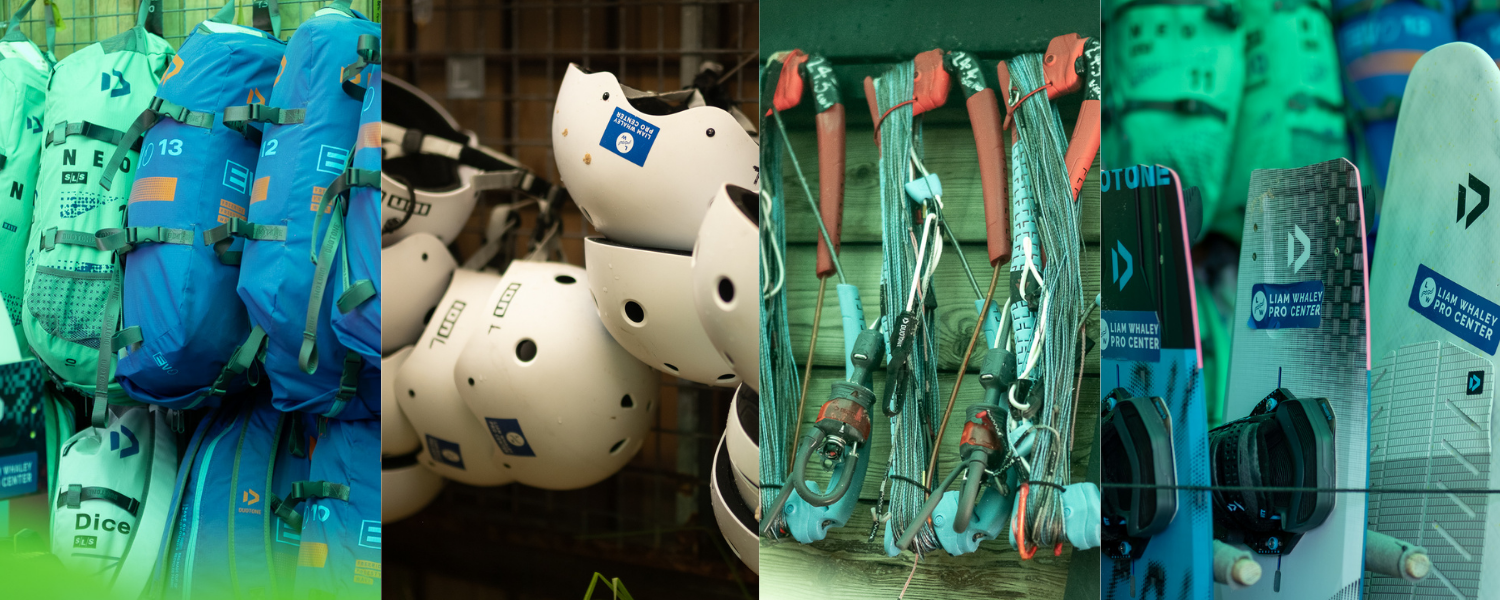
| Gear | What it does | What beginners use |
|---|---|---|
| Kite | Creates the power that pulls you through the water. | A stable Duotone Neo or light one-strut kite, usually on short 10 to 12m lines. |
| Bar and lines | Steer the kite and connect you to the safety release. | A standard bar with a full safety system. |
| Harness | Takes the kite’s pull off your arms and spreads it through your body. | A waist or seat harness, fitted on the day. |
| Board | Helps you start riding once you can control the kite. | A large, stable twin tip, introduced after kite control and body dragging. |
| Wetsuit | Keeps you warm during stops, resets, and practice runs. | A 4/3 or 3/2 wetsuit, depending on the season and conditions. |
| Helmet and 50N buoyancy aid | Help protect you and keep you floating. |
Mandatory for every lesson. The helmet includes a radio so your instructor can guide you from the beach. |
Why is beginner kitesurf gear set up for control, not power?
Your first setup is built around control and safety, not going big or sending it.
The instructor’s weighing up four things: your weight, your level, the wind, and where you are in the lesson. From that they pick the kite and line length that’ll help you learn safely. Get those right and progress feels smooth. Get them wrong and you spend the whole session fighting the gear.
“With the conditions here, you need the right kite for the day, that’s what the rack is for.” says Matteo Micheletta, manager at Liam Whaley Pro Center. “That’s what the rack is for.”
On a strong Levante morning he might rig a small kite for himself. For a beginner, the team makes that call for you, reading the same wind off the same beach.
A bigger kite gives you more power, not faster progress. The setup you actually want is the one that lets you feel what the kite’s doing, make little corrections, and stay balanced.
That’s control. And control is really what those first lessons are about.
⤷ Reading the Tarifa forecast is a skill of its own, and it’s the one that sets your kite size before you even get wet. We break down how we read it in how the forecast shapes your learning.
⤷ Ready to get your first hours on the water? View kitesurfing lessons in Tarifa.
Does your lesson format change the gear you use?
A little, yes, mostly in how much the kite and board are yours for the session.
In a private lesson, it’s one student and one instructor, with a full set of gear set up just for you. You’re on the kite the whole time and the instructor stays with you, which really matters on a busy Valdevaqueros day when the wind’s up.
In a semi-private lesson, it’s two students with one instructor. Sometimes you rotate on one kite, sometimes one of you rides while the other watches the feedback and gets ready for the next go. You get less time on the bar than in a private, but more time to stop, watch, and take it in.
In a group lesson, a small group shares an instructor, so it’s more of an introduction, flying the kite, learning the wind window and the safety system, with more rotation on the gear.
The gear itself is the same, fitted the same way. The format just changes how much of the session is hands-on for you. We break it all down in kitesurf lesson formats in Tarifa.
When am I ready to rent kitesurf gear in Tarifa?
Rental makes sense once you can ride on your own, not after some set number of lessons.
In real terms, that means you can hold upwind, get your own board back, and launch and land safely. Hit that point and the whole rack opens up for the week. Not quite there? A few more lessons will get you there quicker than going it alone.
None of this is pass-or-fail. When you turn up, we walk down to the water with you and look at the conditions together. If the day suits you, you ride. If a strong Levante’s asking more than you’re ready for, we swap the rental for a lesson and close the gap.
It costs nothing to find out where you stand.
Plenty of riders sit somewhere between lessons and full independence. Comfortable in a light Poniente, not so sure in a strong Levante. That’s completely normal, and it’s not a step backwards.
A refresher, a private session, or some supervised time near an instructor can close that gap.
We run through the options in our guide to kitesurf lesson formats in Tarifa.
When you do rent, you pick between Standard and Premium kit. Standard is a Duotone Neo or Evo with a twin tip, and for a newly independent rider that’s usually the smart, predictable choice.
Premium is the SLS line, lighter and quicker, and it makes more sense once you know what you want out of a session. The right kit is the one that matches your level, not the flashiest thing on the rack.
Already riding on your own and after the full quiver for the week? Check the kitesurf rental options.
Still working toward independent riding? Our guide on how long it takes to learn kitesurfing in Tarifa explains the typical progression, while our kitesurf lesson formats guide helps you choose the best way to reach that goal.
Should you rent kitesurf gear in Tarifa or bring your own?
Once you can ride independently, renting in Tarifa usually beats flying out with your own quiver. You travel lighter, match your kite to the day, and keep everything right where you ride.
In a place where the wind can turn on you fast, that flexibility is worth a lot.
You travel light.
A wetsuit and a few bits fit easily in your bag. No kite bags at check-in, no oversize fees, no board doing laps on the carousel in Málaga.
You match the day, not your luggage.
With a full rack to pull from, you size down when Levante’s blowing hard or size up when the wind drops. You’re not stuck forcing one packed kite to work in the wrong conditions.
Everything’s on the beach.
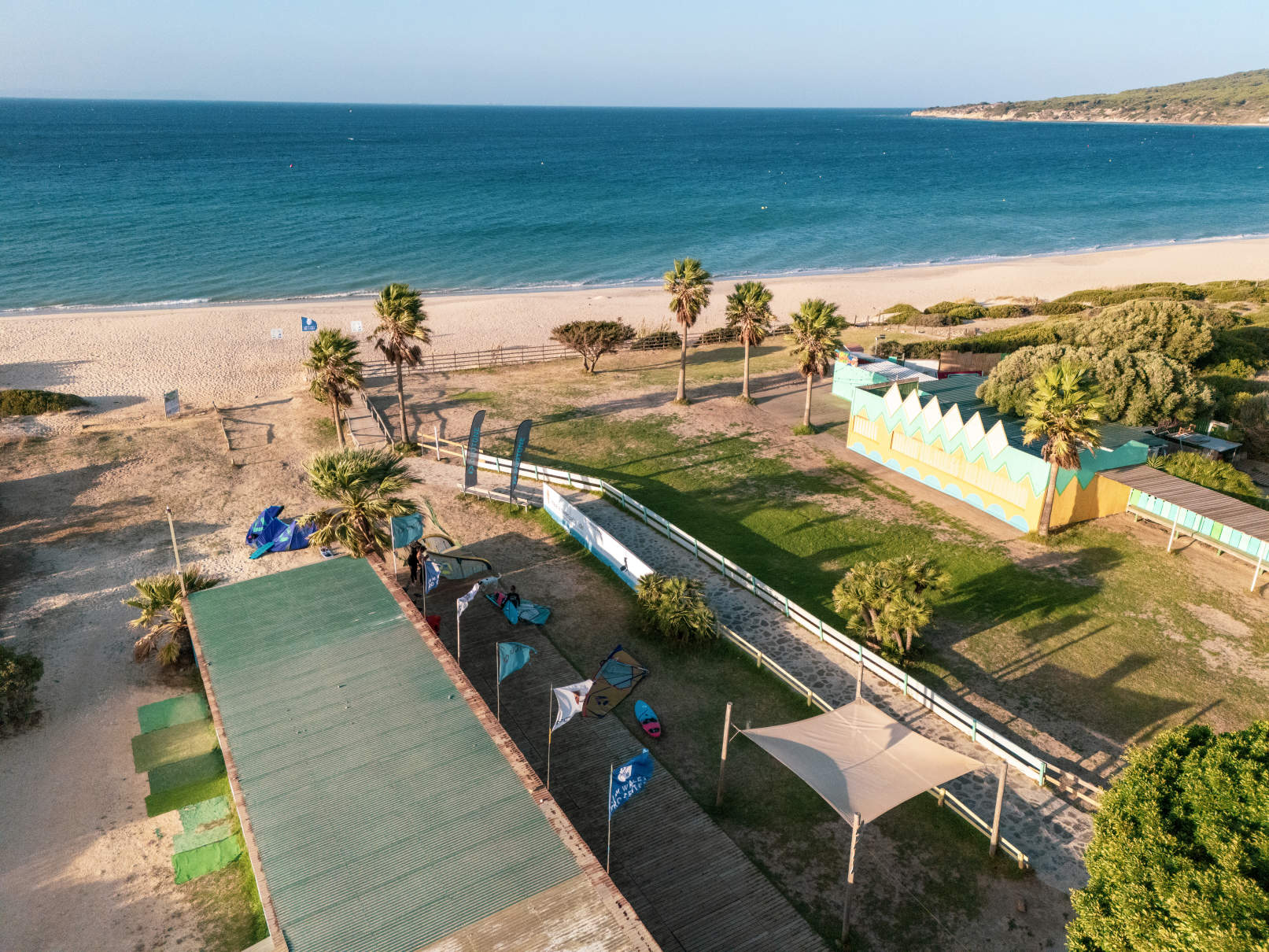
We’re right on Valdevaqueros, compressor, changing rooms, chill-out area, and rescue boat all in one spot. You park, check the wind, grab the right setup, and go.
⤷ Take a quick tour of the center.
I’ve flown a kite before and have gear in the garage, should I bring it to lessons in Tarifa?
If you’ve had a few goes at kitesurfing, maybe a taster somewhere else, and there’s a kite and board sitting in your garage, it’s natural to wonder whether to fly it out to Tarifa. The thinking is usually one of two things: it’ll be cheaper, or you’ll get used to your own gear faster. At this stage we’d still put you on the school’s gear, and here’s why.
First, we match the setup to the day. Levante and Poniente behave completely differently, and the right kite size shifts with the wind, your weight, and what you’re working on. We rig that from our own rack on the beach, so you’re never out there overpowered on the wrong kite.
Second, we know our gear inside out. Every kite, bar and board is checked, current, and set up the way we teach, so nothing surprising happens mid-session. That’s a safety thing as much as a learning thing.
Third, gear takes a beating while kite control is still coming together. Crashes, sand, dragged lines and hard relaunches all add up. Better to put those early bumps on school kit that’s new and built to absorb them than on the kite you want to keep nice. Once your control is solid, bringing your own makes much more sense.
⤷ Want to get to that point quicker? See kitesurf lessons in Tarifa.
I’ve finished a course but I’m not confident in strong Levante, should I practise on my own gear?
If you’ve come through a full course, or you’re riding but freeze up the moment a strong Levante fills in, and you’re wondering whether to bring your own gear out to practise on, you’ve got options. We can run it either way: a supervised session on your own kit, or on ours.
On your own gear, the upside is familiarity, your bar, your kite, the setup your hands already know. We’ll check it over first to make sure it’s safe and in good condition before you take it out.
On school gear, the upside is the right size for the day and zero wear on your own kite. On a gusty Levante day off Valdevaqueros, that lets you put everything into the riding instead of babysitting your setup. Either way the price is the same, so it comes down to what helps you most that day.
Most riders in this spot get the fastest gains from a session or two in stronger wind with someone watching, working on depowering early and holding upwind when it gusts.
⤷ See how a supervised session works with kitesurf coaching and supervision in Tarifa.
Should I bring my own gear for kitesurf coaching in Tarifa?
If you’re already riding and booking in for coaching to push your level, bringing your own gear is usually a good idea, unless you’d rather rent afterwards to keep practising once the session ends. Both work, so it comes down to what you’re working on.
Bringing your own makes sense because you’re dialled into your setup, your bar throw and kite feel are already muscle memory, and you take everything you learn straight home on the same gear.
Renting makes sense if you’d rather skip the travel hassle, match the day’s wind, light Poniente or strong Levante, without lugging a full quiver, or keep riding after the coaching block. We’ll sort sizes for the conditions on Valdevaqueros.
For coaching specifically, we run radio headsets, so your coach talks you through each pass in real time from the beach, which is hard to beat for fixing things fast. We also keep gear matched to specific goals. If you’re working on board-offs, a kite like a Rebel makes it far easier than grinding away on a Vegas, which is brilliant for freestyle but works against you for board-offs. Sometimes the quickest progress is just being on the right tool.
⤷ See what a session covers on kitesurf pro coaching in Tarifa.
FAQ
Do I need to bring my own kitesurf gear for lessons in Tarifa? +
Nope. For lessons with us, the gear is provided and fitted on the day: kite, bar, board, harness, wetsuit, helmet, and a 50 Newton buoyancy aid.
All you bring is swimwear, sunscreen, and a towel.
What kite size do beginners use in Tarifa? +
There is no one beginner size. It comes down to the wind, your weight, your level, and the stage you are at.
Stronger wind means a smaller kite. Lighter wind means a bigger kite. Your instructor sets the kite size from the beach. First lessons usually run short 10 to 12 metre lines for calmer, easier handling.
What board do beginners learn on? +
Most beginners learn on a twin tip, a symmetrical board you ride both ways without moving your feet.
We use a big, stable beginner board so those first rides come easier. It comes out after you can control the kite and body drag, not in the first hour.
Can I rent kitesurf gear after one lesson? +
Usually not. One lesson is about wind awareness, kite control, and the safety system. That is the start, not independence.
Rental opens up once you can ride upwind, recover your own board, and launch and land safely on your own.
When am I ready to rent kitesurf gear? +
You are ready when you can hold upwind, get your board back by body dragging, launch and land safely, and use your safety system without having to think about it.
When you arrive, we do a quick level check on the beach with you. If the day suits you, you ride. If not, we swap to a lesson.
Should I choose Standard or Premium rental gear? +
For a newly independent rider, Standard is usually the better shout. It uses a Duotone Neo or Evo with a twin tip, which feels stable and predictable while you build consistency.
Premium is the SLS line. It is lighter and more reactive, and it makes more sense once you know what you are after in a session.
Should I buy my own kitesurf gear before lessons? +
Usually not. Learn first, then decide.
After a few sessions, you will know the wind you ride, the style you enjoy, and the kit that fits your level. That makes for a much better first purchase than a guess made before you have even started.
Ready to start? → See kitesurf lessons in Tarifa and book your first hours on the water.
Latest News
- Levante vs Poniente for Wingfoil Lessons in Tarifa
- Levante vs Poniente for Kitesurf Lessons in Tarifa
- Is September a Good Month to Learn Kitesurfing or Wingfoiling in Tarifa?
- Am I Ready to Rent Kitesurfing Gear in Tarifa? (Or Do I Need More Lessons?)
- Wingfoiling for Kids in Tarifa: What Parents Should Know Before Booking
- Kitesurfing or Wingfoiling for Kids in Tarifa: Which Should They Try First?
- What Will You Learn in Wingfoil Lessons in Tarifa? From Day One to Independent Riding
- Is Tarifa a Good Place to Learn Wingfoiling? What We Tell Beginners Before They Book
- What Happens in Your First Wingfoil Lesson in Tarifa? We Get Asked This a Lot
- Am I Too Old to Learn Kitesurfing at 50 or 60 in Tarifa?