
How to Choose the Right Kitesurf Setup for the Day in Tarifa
If you’re planning to rent kitesurf gear in Tarifa, Liam Whaley Pro Center has a wide range of Duotone equipment ready at our beachfront center. Our rental fleet includes the latest models in different kite and board sizes, so you can choose a setup that suits your riding style, level, session goals, and the conditions on the day.
In this guide, we will walk you through the equipment available to rent and the main things to consider when choosing your setup. You will learn how your level, the wind, the water conditions, and the type of riding you want to do all affect the kite and board that suit you best.
Renting also keeps the choice flexible. You are not tied to one kite you packed and hoped would work. You ride what suits the day, and because the full fleet is on the beach, you can swap kite or board sizes as the wind changes through your session.
Rental is for independent riders. You should be able to ride upwind, recover your own board, and launch and land safely.
⤷ Not there yet? Start with kitesurf lessons in Tarifa, including a guide to the equipment used during lessons.
Our team will be there to help. We will assess the conditions with you, answer any questions, and suggest a setup that makes sense for your session.
⤷ Explore the kitesurf rental fleet and booking options, and for a real example of gear selection on a lighter-wind day, watch the Duotone demo day video.
How do you choose a kitesurf setup for the day in Tarifa?
Three questions decide your setup, and it helps to take them in order.
-
What is the wind doing? Whether it is Levante or Poniente, and how strong. The wind comes first because it sets your kite size more than anything else.
-
What is your level and weight? These fine-tune the size and rule some setups in or out. A heavier rider needs more kite in the same wind, and a newer rider wants a more forgiving one.
-
What do you want from the session? Cruising, jumping, freestyle, or riding waves. Your goal is what points you to the model, because two riders in the same wind can want very different kites.
We will take each of these in turn, starting with the wind, since in Tarifa that is what changes most from one day to the next.
How do Levante and Poniente change your kitesurf setup in Tarifa?
Tarifa runs on two main winds, and they ride completely differently. Knowing which one you have is the first move, every time.
Levante comes from the east, side-offshore, and it is the strong one. It often blows 20 to 40 knots, gusty and punchy, with flatter water on the inside. That points you to smaller kites and the kind of power that suits jumping and strong-wind riding. It is less forgiving, so it rewards riders who are comfortable being properly powered.
Poniente comes from the west off the Atlantic, side-onshore and steadier, usually around 12 to 22 knots, sometimes with a bit of swell. This is the friendlier wind: bigger kites, relaxed freeride, wave riding, and light-wind foil sessions. The side-onshore direction also makes it easier to get back to the beach.
The thing to plan around is that Tarifa switches. You can ride a soft Poniente one day and a strong Levante the next, which is exactly why adjusting your setup beats committing to one kite. Before your session, it pays to check what is coming.
⤷We break that down in how the forecast shapes your session and how to read Windguru for Tarifa.
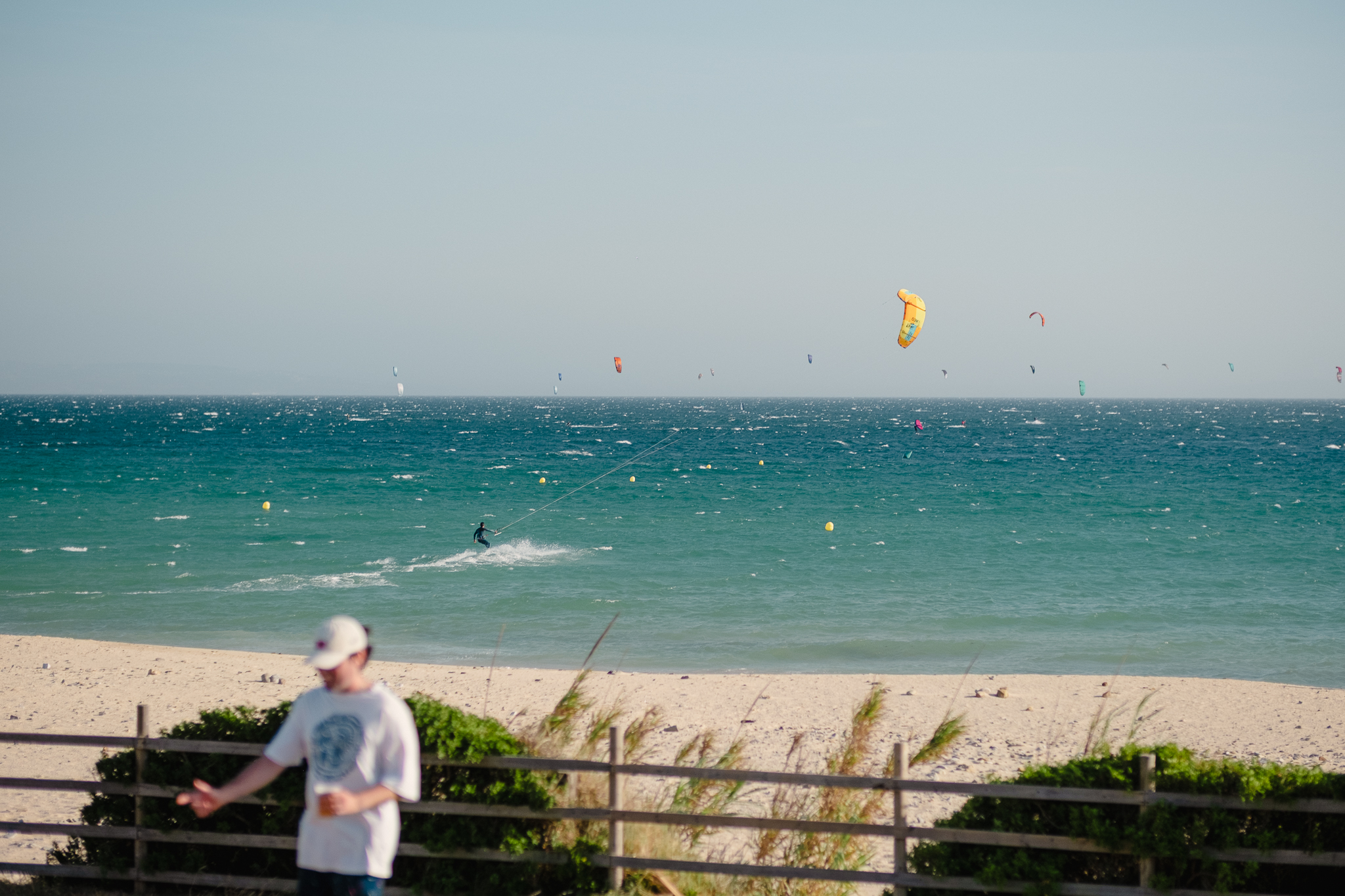
What kite size do you need for the wind in Tarifa?
Size comes down to three things: the wind, your weight, and your level. As a rough starting point for a rider around 75 to 80 kg:
-
Light Poniente: a big kite, roughly 12 to 15m.
-
A solid mid-range day: around 9 to 12m.
-
Strong Levante: a small kite, roughly 6 to 9m, sometimes smaller.
Lighter riders size down, heavier riders size up. If you only remember one number, a 12m is the everyday all-rounder for average wind and weight. And when you are unsure, go a touch smaller. An underpowered kite is frustrating, but an overpowered one is dangerous.
Our rental fleet covers the full range, with kites in 3, 5, 7, 9, 11, 13, and 15m, so whatever the day brings, there is a size to match it.
Do not get hung up on the exact number before you arrive. When you reach the beach, the team reads the day and sets you up with the right size, matched to the wind and how you ride.
⤷ It is also why renting beats one fixed setup. In the Duotone demo day video, Liam started a light Poniente session on a 12m Rebel, then switched up to a 13m Evo for more hang time when the wind stayed soft. That is the call happening in real time.
Can you change your kite size during the day in Tarifa?
Yes, and it is one of the best reasons to rent here rather than travel with your own kit.
Tarifa’s wind does not always hold. A session can start in a soft Poniente and build through the afternoon, or a strong Levante can ease off. When that happens, you do not have to push through on the wrong kite. You come in, swap to a bigger or smaller size, and get back out.
Everything you need is right there on the beach: the full rack, the compressor, and the team. Changing your setup takes a few minutes, not a drive back to your apartment. You can also switch models if your plan for the session changes, say from a freeride kite to something built for jumping.
This is the thing a packed quiver cannot match on a trip. Travel with one kite and you are stuck with whatever you brought. Travel with three and you are paying excess baggage and still guessing days before you have seen the forecast. Renting on the beach means you ride the size the day actually calls for, every session.
⤷ See the full range and how it works on the kitesurf rental page.
Which Duotone kite matches your goal?
Two riders can be on the same size in the same wind and still want completely different sessions. That is where the model comes in. Everything here is current Duotone gear, so it comes down to which kite suits what you want to do.
Freeride and progression: the Evo (or Neo)
If you want to cruise, build consistency, and start working on your first jumps and transitions, the Evo is the all-rounder. It is stable, forgiving, and holds a wide wind range, which is exactly what you want when the conditions are moving around. It is the kite most riders are happiest on day to day.
If you ride strapless, the Neo gives you that same easy, predictable feel with a lighter, driftier character that suits a surfboard under your feet.
“It is a very good freeride kite, unless you ride strapless, where the Neo makes more sense,” says Matteo Micheletta, manager at Liam Whaley Pro Center.
Big air and boosting: the Rebel SLS
If your session is about going big, the Rebel SLS is the one. It is built for lift and hang time, the floaty, lofted jumps Tarifa is known for when a strong Levante turns on. It is Liam’s favourite kite for big air and old school, the first thing he reaches for when the plan is going big.
The reasons are simple. It sends you high with plenty of hang time, and the landings come in soft. The kite loops are easy too, with little pull through the loop, so you decide how much power to generate. The SLS construction makes it lighter and quicker to steer than the standard Rebel. And it is not only for experts: it carries you from your first proper jumps to competition-level riding, which is why more young pros have been reaching for it.
“Fly high, lots of hang time, easy kite loops, soft landings. What else do you want?” says Liam Whaley. “This kite is epic. It’s my kite of choice within the whole Duotone range.”
⤷ Want to see it ridden? Watch Liam testing the Rebel D/LAB and revealing the Rebel SLS. The model years differ, but the lift and hang time are exactly what this kite is about.
Freestyle and unhooked: the Dice
If you are riding unhooked and working on freestyle, the Dice is the one. It is quick and precise, with the pop and slack you need to load up and throw your tricks.
It also shines in lighter wind, which makes it a great kite to get into freestyle without waiting for a big day. For the conditions you usually get at Valdevaqueros, it is the freestyle kite to be on.
“We keep the Dice to unhook, and to have a bit of variety in the quiver,” says Matteo Micheletta.
Strapless and waves: the Neo
When there is swell at Valdevaqueros and you want a surfboard under your feet, the Neo is the kite. It is light and drifty, so it holds its shape and sits quietly as you ride down the line, rather than pulling you off the wave.
That drift is the whole point. You can let the kite fly while you work the board and the wave, then bring the power back when you need it. Pair it with a strapless board like the Whip or the Blur, sized to your weight and the day.
In the demo day video, pro rider Camille Losserand rides this setup, a good look at how the Neo handles on a strapless board.
Light-wind days: bigger sizes and the Evo SLS
When Poniente goes soft, the move is to go bigger and lighter. A larger Evo SLS flies in less wind while staying easy to handle, so a marginal forecast still turns into a session.
“The Evo SLS is a very good machine in strong winds and light wind as well,” says Matteo Micheletta.
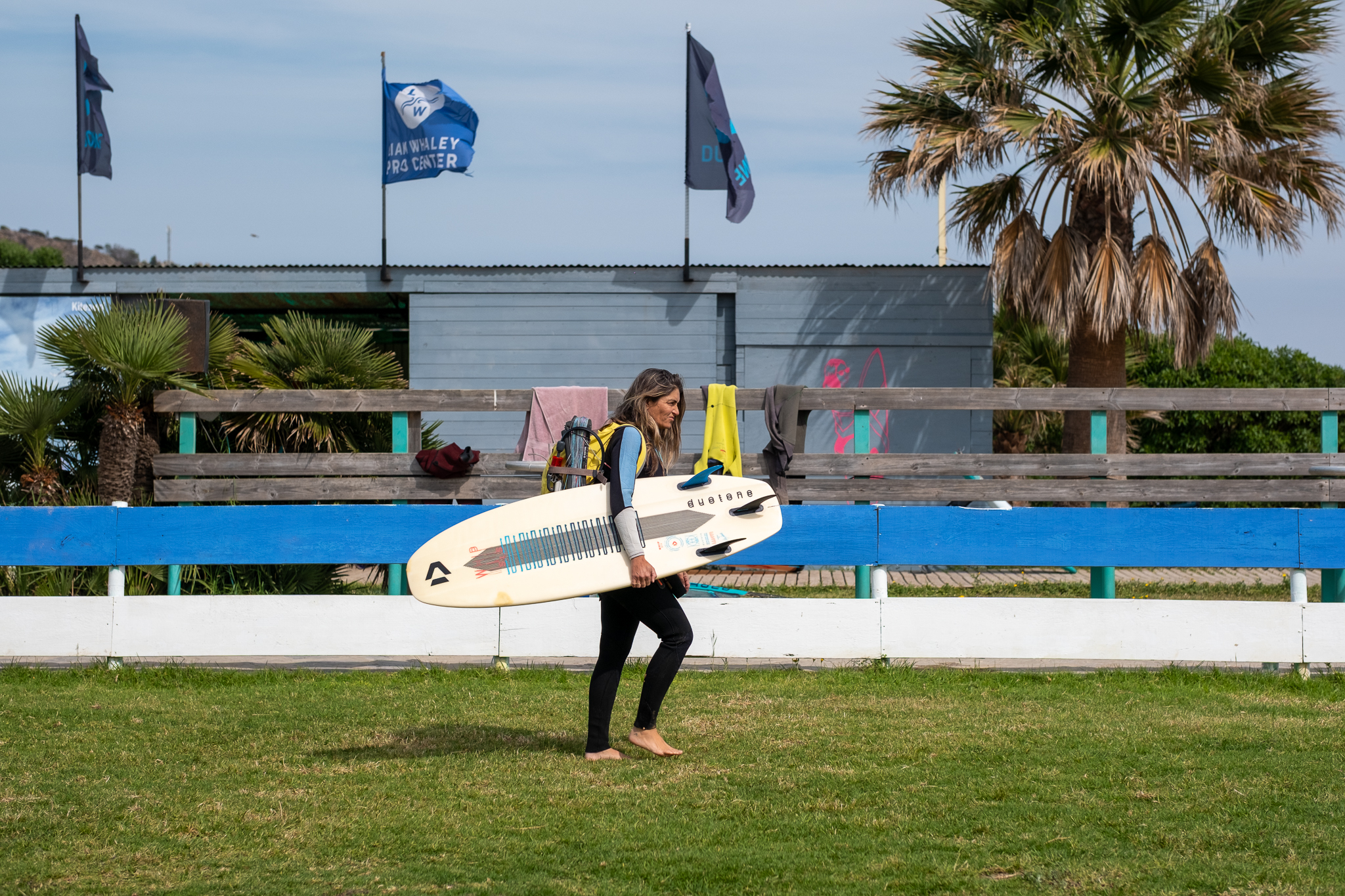
| Your goal | Reach for | Why |
|---|---|---|
| Freeride and progression | Evo (or Neo) | Stable, forgiving, wide wind range. The everyday all-rounder. |
| Big air and old school | Rebel SLS | Lift, hang time, soft landings, easy loops. Liam’s kite of choice. |
| Freestyle and unhooked | Dice | Quick and precise, with the pop and slack for tricks. Strong in lighter wind. |
| Strapless and waves | Neo + Whip or Blur board | Light and drifty, sits quiet while you ride down the line. |
| Light wind | Bigger Evo SLS / foil | Flies in less wind. Foil for the really marginal days. |
You do not need to own any of these. Rent the one that fits today’s goal, ride a different one tomorrow, and let the team match it to the wind. That is the real advantage of choosing your setup here instead of buying it.
What about foiling on the light days in Tarifa?
When Poniente goes really light, below what a twin tip can use, a foil keeps you riding. It needs far less wind to get going, so a soft, marginal forecast still turns into a session instead of a day on the beach.
“With the foil, we open a big door for the amount of time on the water,” says Matteo Micheletta.
Foil setups are part of the Premium rental, and the team will match the board and front wing to the day. Foiling rides differently to a twin tip, so if you are new to it, you can take a lesson first.
⤷ See the foil and the rest of the fleet on the kitesurf rental page.
Should you rent Standard or Premium in Tarifa?
Both tiers are quality Duotone gear. The difference is build and intent: Standard is the rugged, everyday kit, and Premium is lighter and more specialised.
Standard is a Neo or Evo with the Trust bar and a Gonzales board. It is the practical, reliable choice for everyday riding, and for most people, especially on a first independent week here, it is the smart call.
Premium is the SLS line: the Rebel, Evo, Neo, and Dice, plus carbon and strapless boards. It is lighter, sharper, and more reactive, and it makes more sense once you know exactly what you want out of a session.
The same split shows up in the boards.
“The standard board uses a cheaper, tougher lamination; the premium boards are carbon, so they are a bit more specific for the discipline you want to do,” says Matteo Micheletta.
The honest version: the more advanced kite is not automatically the better one. The right kit is the one that matches your level and your goal, not the flashiest thing on the rack.
⤷ You can see the full lineup and book your dates on the kitesurf rental page.
I can just about ride upwind, what should I rent in Tarifa?
If you have just become independent, and you can hold upwind on a good day but it still feels like work, this one is for you. It is one of the most common spots to be in, and the right call here is more about the day and the setup than about pushing yourself.
What makes or breaks it at this level is the wind. A steady Poniente at Valdevaqueros, side-onshore and smooth, is your friend. A gusty, punchy Levante is not. It will overpower you and make holding upwind twice as hard.
So go for a forgiving Standard setup: a stable Neo or Evo, sized so you are comfortably powered rather than maxed out, on a bigger, grippy Gonzales board that helps you hold your line and get back upwind. Pick a steadier day, stay in the area the team points you to, and you will get far more from the session than you would fighting a small kite in strong wind.
And be honest at the level check. When you arrive, the team walks down to the water with you and reads the day. If you are drifting downwind on the first couple of tries, they will land the kite and switch you to a quick lesson or refresher rather than send you out to struggle. That is not a setback, it is the fastest way to riding the rack freely.
⤷ Not sure where you stand? Come by and we will check it together. See the setups on the kitesurf rental page, or book a lesson or refresher if the day calls for it.
Which kite should I ride for a big-air session in a strong Levante at Valdevaqueros?
If you came to Tarifa to boost, a strong Levante morning at Valdevaqueros is the day you were waiting for. East wind, side-offshore, often 25 to 35 knots, flatter water on the inside, and enough power to send you high.
The mistake is sizing for the gusts and ending up overpowered, which wrecks your timing and your nerve. In a punchy Levante you want to be comfortably powered, in control of the bar, not hanging on.
For most riders that means a smaller kite, often in the 7 to 9m range depending on your weight and how hard it is blowing, on the Rebel SLS, Liam’s pick for big air. If it keeps building through the session, size down again rather than push it. We will size you for the gusts before you launch, and because Levante is offshore, the rescue boat is on the water the whole time, which matters more than usual.
⤷ Want the right size dialled for the day? Come find us, the full quiver is on the kitesurf rental page.
Which board and kite should I rent for strapless riding in Tarifa?
If you ride strapless, you read Tarifa differently to the twin-tip crowd. You are watching for a Poniente with some swell, when Valdevaqueros gets a bit of texture and there is something to ride down the line.
The wrong kite makes strapless harder than it needs to be: too much bar pressure, not enough drift, and the kite fighting you through the turns instead of sitting quiet while you work the wave.
This is the Neo’s home. It sits quiet and holds its drift, so it parks where you put it and lets you focus on the board. Pair it with a strapless board like the Whip or the Blur, sized to your weight and the day. On a wavier Poniente we will talk size with you, because what works in clean light wind is not the same as what works when there is chop and current.
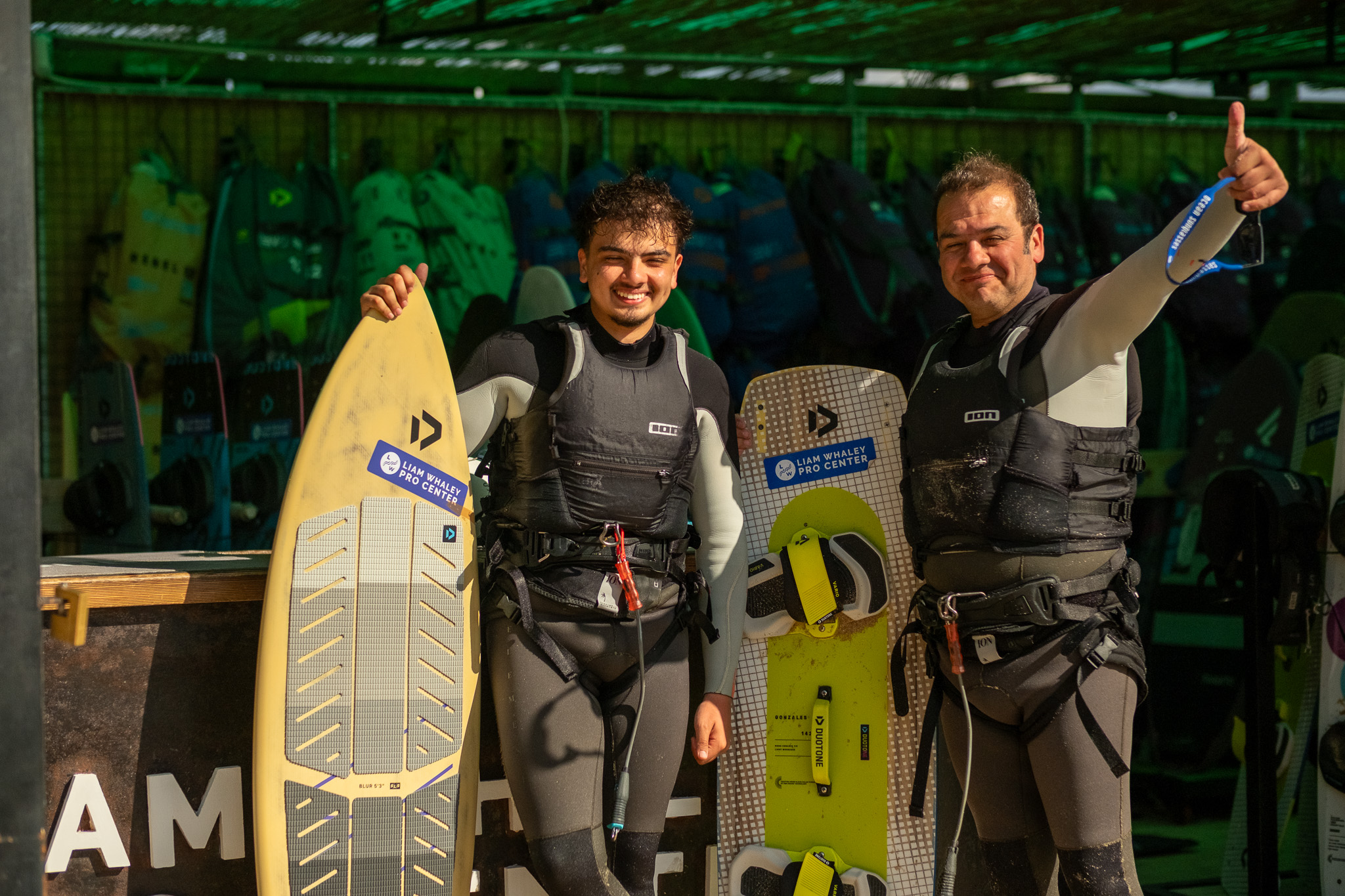
⤷ Riding strapless on your trip? Tell us and we will have the Neo and a board ready. Details on the kitesurf rental page.
FAQ About Choosing a Kitesurf Setup in Tarifa
What kite size do I need in Tarifa? +
It depends on the wind, your weight, and your level. For an average rider, light Poniente often calls for 12 to 15m, a mid-range day around 9 to 12m, and a strong Levante 6 to 9m or smaller.
A 12m is the everyday all-rounder, and the team sets your exact size on the beach once they have read the day.
Which Duotone kite is best for big air in Tarifa? +
The Rebel SLS. It is built for lift and hang time, it is Liam’s kite of choice for big air and old school, and it works from your first proper jumps to competition-level riding.
Pair it with a smaller size so you stay comfortably powered.
Which kite is best for waves or strapless? +
The Neo. It is light and drifty, so it sits quiet while you ride down the line.
Pair it with a strapless board like the Whip or the Blur.
Can I change kite size during the day? +
Yes. That is the main advantage of renting on Valdevaqueros.
The rack, compressor, and team are all on the beach, so you can size up or down, or switch model, in a few minutes as the wind shifts.
Should I rent Standard or Premium for my first independent week? +
Standard is usually the smarter call. A Neo or Evo with the Trust bar and a Gonzales board is stable and predictable while you find your feet here.
Premium SLS makes more sense once you know exactly what you want from a session.
Do I need to bring my own kite gear to Tarifa? +
No, and for most riders it is better not to.
Renting lets you match the kite to the day’s wind and swap sizes as it changes, instead of forcing one packed kite to work in conditions it was not picked for.
Rebel or Dice? +
Rebel if your session is about big jumps and hang time.
Dice if you are working on unhooked freestyle and want pop and slack. They are built for different goals, not better or worse.
Ready to get the right setup on the beach?
Tell the team your level, your dates, and what you like to ride, and they will have the right kite, board, and size ready when you arrive, then swap it as the wind changes through your stay. Start on the kitesurf rental page.
Want to see how the call gets made first? Watch Liam read a light day and switch kites in the Duotone demo day video. And if you are still building toward independent riding, our kitesurf lessons in Tarifa will get you there.
Latest News
- Kitesurfing vs Wingfoiling: Which Should You Learn in Tarifa?
- Private, semi-private or group wingfoil lessons in Tarifa: which should you choose?
- How Fit Do You Need to Be to Learn Kitesurfing in Tarifa?
- How long does it take to learn kitesurfing in Tarifa?
- Beginner Kitesurfing Course in Tarifa: From Day One to Independent Riding
- How to Choose the Right Kitesurf Setup for the Day in Tarifa
- What Is Included in a Kitesurfing Lesson in Tarifa (and What to Bring)?
- Duotone Kite Demo Day in Tarifa: Testing the Latest Kites at Liam Whaley Pro Center
- Kitesurf Lesson Formats in Tarifa: Private, Semi-Private or Group?
- Your First Kitesurfing Lesson in Tarifa: What to Expect