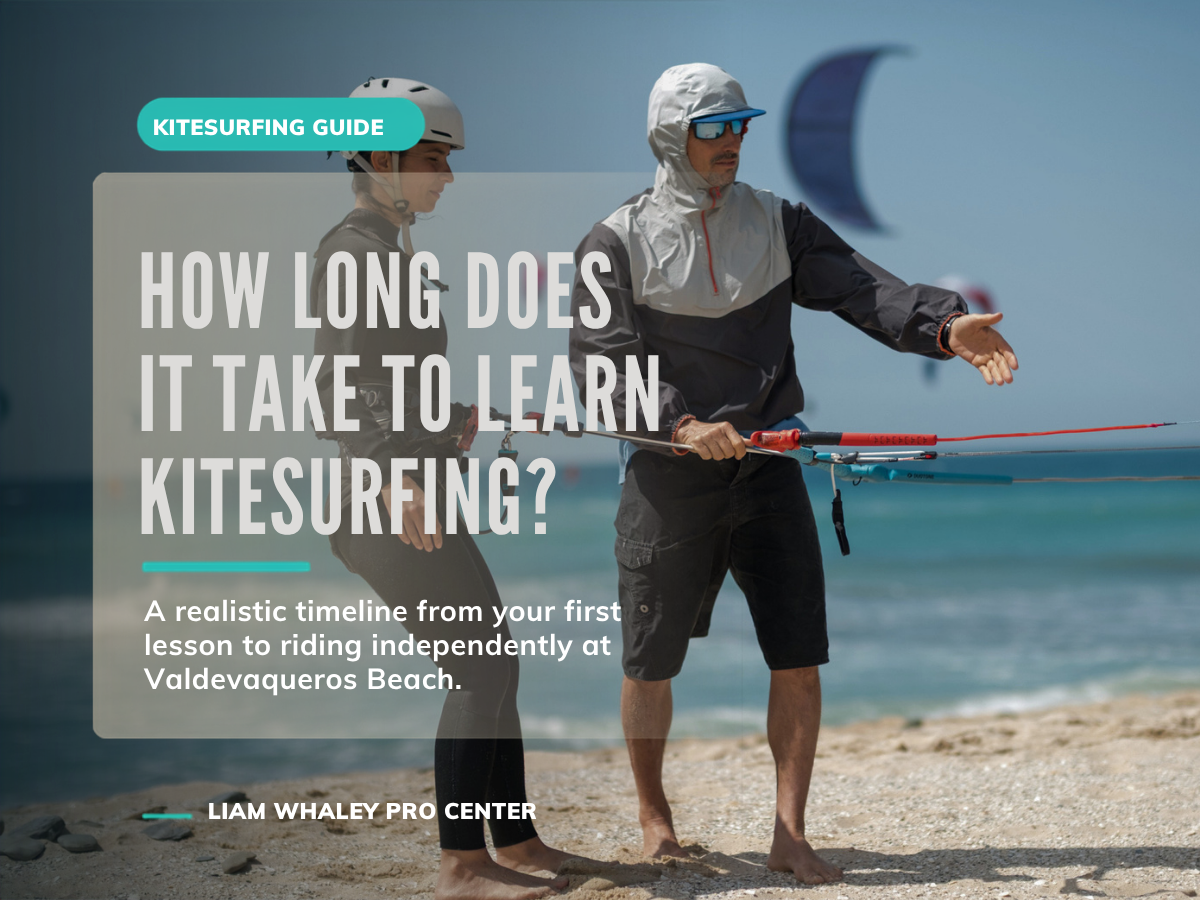
How long does it take to learn kitesurfing in Tarifa?
Most beginners should plan on at least 12–15 hours of kitesurfing lessons in Tarifa to make meaningful progress. That is enough for many people to move from basic kite control toward waterstarts and first rides. It is not a promise that you will be ready to ride alone. Getting your first rides is one milestone. Riding safely on your own takes longer.
At Valdevaqueros, every session can feel a little different. A smooth Poniente session may give you long, clean repetitions. A gusty Levante day can mean a smaller, faster kite and more time building control. The wind does not follow your booking calendar.
Former student Dominic Green summed it up well in his Google review: “Allow plenty of time. Kitesurfing is not a quick-win sport.” Giving yourself some margin allows the team to work with the usable wind instead of forcing every lesson into a fixed slot.
Learning to kitesurf happens in stages. First, you learn the safety systems and how to control the kite on land.
Then you move into the water for body dragging, recovering your board and managing the kite and board together. Waterstarts and first rides come after those foundations are in place.
The next milestone is riding upwind, so you can return to the same part of the beach instead of walking back. Only then do you become an independent rider, able to manage the kite, the board and the conditions without an instructor next to you.
Your lesson format changes how much time you actively control the kite. Previous board-sport experience, water confidence and how closely you space your sessions matter too. Two students can book the same 12 hours and leave Tarifa at very different points. Lesson hours are useful for planning, but your actual level comes down to what you can do safely.
How long does it usually take to learn kitesurfing in Tarifa?
At Liam Whaley Pro Center, beginner lessons usually run in two-hour sessions. Most students need around 12 to 15 hours in total, which works out to roughly six to eight sessions. By that point, the average beginner should be riding upwind, recovering their board and controlling the kite well enough to be assessed for independent rental.
The number of hours is still a guideline. Before renting equipment, the team checks that the rider can hold their position upwind, recover the board and manage the kite safely without an instructor beside them. If one of those skills is not consistent yet, the instructor may recommend another supervised session.
Some people progress more quickly, especially if they have experience in wakeboarding, snowboarding, surfing, sailing or windsurfing. Others need more time to feel comfortable in the water or to develop confidence with the kite. Both are completely normal.
The important part is what the student can do at the end of the course. Twelve to fifteen hours is the usual learning range, but the final decision about independent riding is based on the skills the rider can demonstrate.
What does “learning to kitesurf” actually mean?
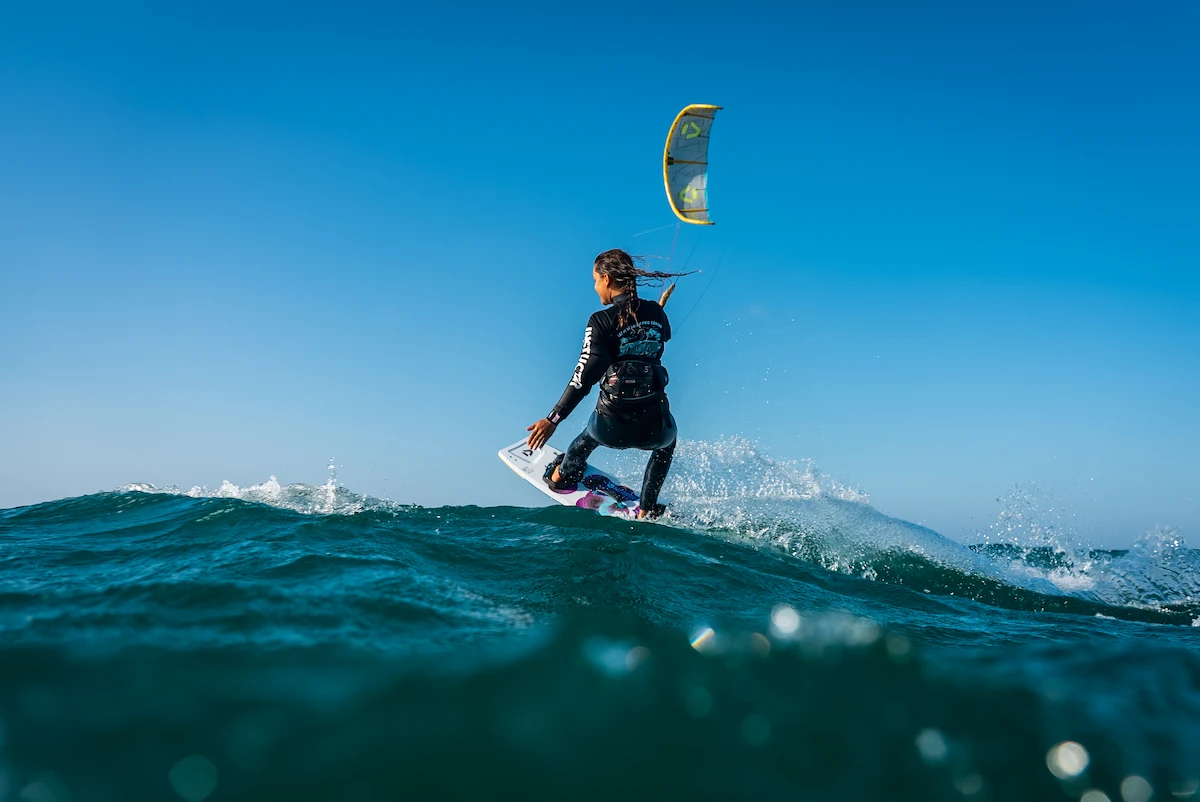
People often use “learning to kitesurf” to describe very different milestones. For one person, it means standing up on the board for the first time. For another, it means riding back to the same part of the beach without help. Those are not the same level.
-
First rides: You can waterstart and ride for a short distance, but you may still lose ground downwind or need help recovering the board.
-
Riding upwind: You can hold your position or return to where you started instead of finishing every run farther down the beach.
-
Riding independently: You can ride upwind consistently, recover your board and manage the kite safely without an instructor beside you.
“To rent with us, you have to stay upwind the whole time without drifting, get your own board back every time, and stay safe launching and landing,” explains Matteo from the center’s rental team.
At Liam Whaley Pro Center, the usual 12–15-hour learning range is intended to take the average beginner toward that third milestone. The final decision is based on the skills the rider can repeat consistently, not on whether they have completed a set number of sessions.
The full beginner progression from first kite control to independent riding explains what happens between these milestones. A first ride is an important breakthrough, but independence means being able to repeat the right decisions when the wind, water and kite do not feel exactly the same.
What can you realistically learn in 6, 10, 15 or 20 hours?
Think of these numbers as a rough guide, not a fixed schedule. Some students move through the early stages quickly, while others need a little more time with one skill before the next one clicks. The wind, the lesson format and your previous experience all make a difference.
| Lesson time | Likely stage | What you may be working on |
|---|---|---|
| 6 hours | Getting the basics down | Safety, kite control and body dragging. You may start working on waterstarts. |
| 10 hours | Starting to ride | Waterstarts and short rides are becoming more reliable. You start learning to stay upwind. |
| 15 hours | Ready for a level check | Upwind riding, board recovery and safe kite control are coming together. This is when many riders are ready for a rental assessment. |
| 20 hours | Making it consistent | More practice helps the skills feel natural and prepares you for a wider range of conditions. |
If everything clicks earlier, great. If it takes a little longer, that is normal too. Kite control, board recovery and upwind riding still need to feel reliable before you move on.
You can see the same progression in students’ own experiences. After a week of beginner lessons, Rory Davidson wrote, “I can now water start!” Nataliia Kuliakina said that after one week she had started “going a little bit upwind.” Neither review gives an exact number of lesson hours, but both show what meaningful progress over a week can look like.
The format you choose also changes how much time you spend with the kite in your hands. Our comparison between private, semi-private and group lessons shows how instructor attention, rotation and active kite time affect your progress.
Do age and previous board-sport experience change the timeline?
Age plays a part, but it usually isn’t what decides how quickly you learn. Some teenagers pick things up fast, some adults do, and some need a little longer. Feeling comfortable in the water, staying relaxed with the kite and practising regularly usually matter more.
If you're wondering whether your fitness, strength or mobility will affect your progress, we've covered that in our "How fit you need to be to learn kitesurfing in Tarifa" guide.
Board-sport experience can help once the board comes into the lesson. If you’ve wakeboarded or snowboarded, edging and weight distribution may already make sense. Surfing can make you more comfortable in the water, while sailing or windsurfing gives you a head start with wind direction.
The board might feel familiar. The kite probably won’t. Everyone still needs to learn the safety systems, body dragging, board recovery and how to manage the kite’s power without fighting the bar.
Age mainly changes how the lesson is paced. A younger student may learn well through movement and repetition. An older learner may prefer a little more explanation, shorter runs or an extra break. Neither approach is better. The instructor adjusts the session, but the standard for riding independently stays the same.
A recent family review gives a good example at the younger end. Thomas Kristensen’s children, aged 13 and 14, had their first kitesurfing experience during a week at the center and left “hooked.” The review doesn’t claim a specific riding level, but it shows that young beginners can enjoy the process when the teaching and safety setup match their age.
Previous experience can change the picture completely. Giovanni Colombo returned to kitesurfing after an accident and a two-year break, then booked 10 private hours over five days. By the end, he was working on toeside transitions and getting close to his first jumps. That’s strong progress, but it isn’t a beginner benchmark. Giovanni was rebuilding skills he already had.
And if you’ve never done a board sport before, that’s completely fine. It simply means the kite and the board are both new, so we take them one step at a time.
Does learning in Tarifa make progress faster or slower?
Tarifa can help you progress quickly, but it won’t make every session easy. There’s usually plenty of wind, and you may get to learn in both Poniente and Levante during the same trip. The trade-off is that the conditions don’t always give you the same kind of practice.
A smooth Poniente session is great for repeating waterstarts and building longer rides. A stronger or gustier Levante session may put more focus on controlling the kite, choosing the right kite size and staying relaxed when the power changes.
So progress can look different from one day to the next. One session you may ride farther. In the next one, you may cover less distance but learn how to keep the kite under control when the wind isn’t perfectly steady. Both count.
As Matteo puts it, “It’s not the easiest spot in Europe, but it’s definitely the most fun.”
For a beginner, the real value of learning here is not simply reaching the first waterstart as fast as possible. It’s getting comfortable enough with changing conditions that you can make good decisions when every session doesn’t feel exactly the same.

How many days should you book for a kitesurfing trip to Tarifa?
If your goal is the usual 12 to 15 hours of beginner lessons, plan at least a full week in Tarifa. With two-hour sessions, that works out to roughly six to eight teaching blocks. The catch is that they won’t always fit neatly into six to eight consecutive days.
On a Poniente day, the wind may fill in later and the lesson time can move by an hour or two. Strong Levante can also change the plan. The instructor may wait for a better window, switch the kite size or use the session for a skill that suits the conditions.
If your dates are flexible, eight to ten days gives you a more comfortable buffer for the full beginner course. For a shorter six-hour introduction, four or five days may be enough if the wind cooperates. These are sensible planning ranges, not a promise that every day will be teachable.
Janwillem van Leeuwen described his trip simply as “a full week of lessons when the weather allowed it.” That’s a good way to plan Tarifa: book enough time for the hours you want, then leave a little room for the wind to decide when those hours happen.
If you want to follow the numbers yourself, the Windguru guide explains what beginners should look at before a lesson. If you’re still choosing dates, the spring guide covers what April, May and June are usually like. And if the wind takes a day off, the no-wind guide gives you a few good ways to use it.
When are you ready to kitesurf without an instructor?
You’re ready to kitesurf without an instructor when you can manage the full session, not just the riding part. You should be able to launch and land safely, control the kite without constant corrections, ride upwind, recover your board and return to the beach under control.
The conditions still matter. A rider who feels independent in smooth Poniente may need more support in a strong, gusty Levante. The team checks whether your level matches the day, not whether you passed a test once in easier wind.
Once those skills are consistent, you can move into kitesurf rental in Tarifa. The team may do a quick level check and help choose the right setup. If they recommend another supervised session first, it simply means one part of the process still needs to become more reliable.
Which kitesurfing lesson option should you choose next?
The right next step depends on where you are now, how much time you have and who you’re learning with.
-
Complete beginner: Start with a first kitesurfing lesson. You’ll learn the spot, safety system and basic kite control before moving toward the water.
-
Limited time, younger rider or nervous in deeper water: A private lesson gives you the most active kite time and the closest support.
-
Learning with a partner or friend at a similar level: Semi-private lessons let you share the experience while keeping the session structured.
-
Returning rider or almost independent: A private refresher or level-check session can focus directly on the skill that is holding you back.
The full comparison of private, semi-private and group lessons explains the trade-offs in more detail.
Once you know the format, you can choose your kitesurfing lesson hours and send the team your travel dates.
FAQ about learning kitesurfing in Tarifa
These are the short answers to the questions beginners usually ask before booking.
How many lessons do you need before you can ride independently? +
Most beginners should plan for around six to eight two-hour sessions if the goal is to work toward independent riding.
Some will need fewer and some more. The final decision comes from the skills you can repeat safely, not the number of lessons on the booking.
Can you learn to kitesurf in one week? +
Yes, you can make real progress in one week. Many beginners reach body dragging, waterstarts or their first short rides.
Reaching full independence is possible for some people, but it depends on the usable wind, lesson format, previous experience and how consistently the skills come together. A flexible trip plan gives you the best chance of using the week well.
Is Tarifa a good place to learn kitesurfing? +
Yes. Valdevaqueros gives beginners wind, space, a dedicated teaching area and support directly on the beach.
The honest trade-off is that Tarifa can also be strong and gusty. It works best when the lesson is adapted to your level and the conditions rather than forced into a fixed plan. Our beginner-friendly Tarifa guide explains the spots, wind and safety setup in more detail.
Is kitesurfing harder to learn if you are older? +
Not necessarily. Older beginners may prefer shorter repetitions, clearer explanations or an extra break, but age alone does not decide the outcome.
Comfort in the water, coordination, concentration and regular practice usually matter more.
Does a private lesson help you progress faster? +
Usually, yes. In a private lesson, the kite stays in your hands and the instructor can correct each attempt straight away.
That often means faster progress, especially if your time is limited, you feel nervous or you’re working through waterstarts. The lesson-format comparison shows when private, semi-private or group tuition makes the most sense.
What is the difference between a first waterstart and riding independently? +
A waterstart means you can use the kite’s power to get onto the board and begin moving.
Riding independently means you can repeat that skill, ride upwind, recover your board and manage the session safely without an instructor beside you. The complete beginner progression shows everything that needs to happen between those two moments.
What should you remember about learning time in Tarifa?
Plan around 12 to 15 hours if your goal is to work toward independent riding, and give those hours enough calendar space. A full week is the minimum we would suggest. Eight to ten days gives the wind more room to cooperate.
If you only have four to six hours, that’s still enough for a proper introduction and meaningful progress. Just treat it as the beginning of the process, not a deadline for reaching the board.
The simple rule is this: count the skills you can repeat, not only the hours you completed. First rides feel great. Riding back safely, getting your board and making the right call when the wind changes is the level that matters.

How can Liam Whaley Pro Center help you choose the right number of lesson hours?
Tell the team your travel dates, whether you’re a complete beginner or returning to the sport, and whether you’re learning alone or with someone else. They can recommend a realistic number of hours, the most suitable lesson format and how much flexibility to leave around the forecast.
See what is included in a kitesurfing lesson, then book your kitesurf lessons in Tarifa with your dates and starting level. You’ll arrive knowing what the course is likely to look like and what the next realistic milestone should be.
Latest News
- Private, semi-private or group wingfoil lessons in Tarifa: which should you choose?
- How Fit Do You Need to Be to Learn Kitesurfing in Tarifa?
- How long does it take to learn kitesurfing in Tarifa?
- Beginner Kitesurfing Course in Tarifa: From Day One to Independent Riding
- How to Choose the Right Kitesurf Setup for the Day in Tarifa
- What Is Included in a Kitesurfing Lesson in Tarifa (and What to Bring)?
- Duotone Kite Demo Day in Tarifa: Testing the Latest Kites at Liam Whaley Pro Center
- Kitesurf Lesson Formats in Tarifa: Private, Semi-Private or Group?
- Your First Kitesurfing Lesson in Tarifa: What to Expect
- How to Read Windguru for Kitesurf Lessons in Tarifa