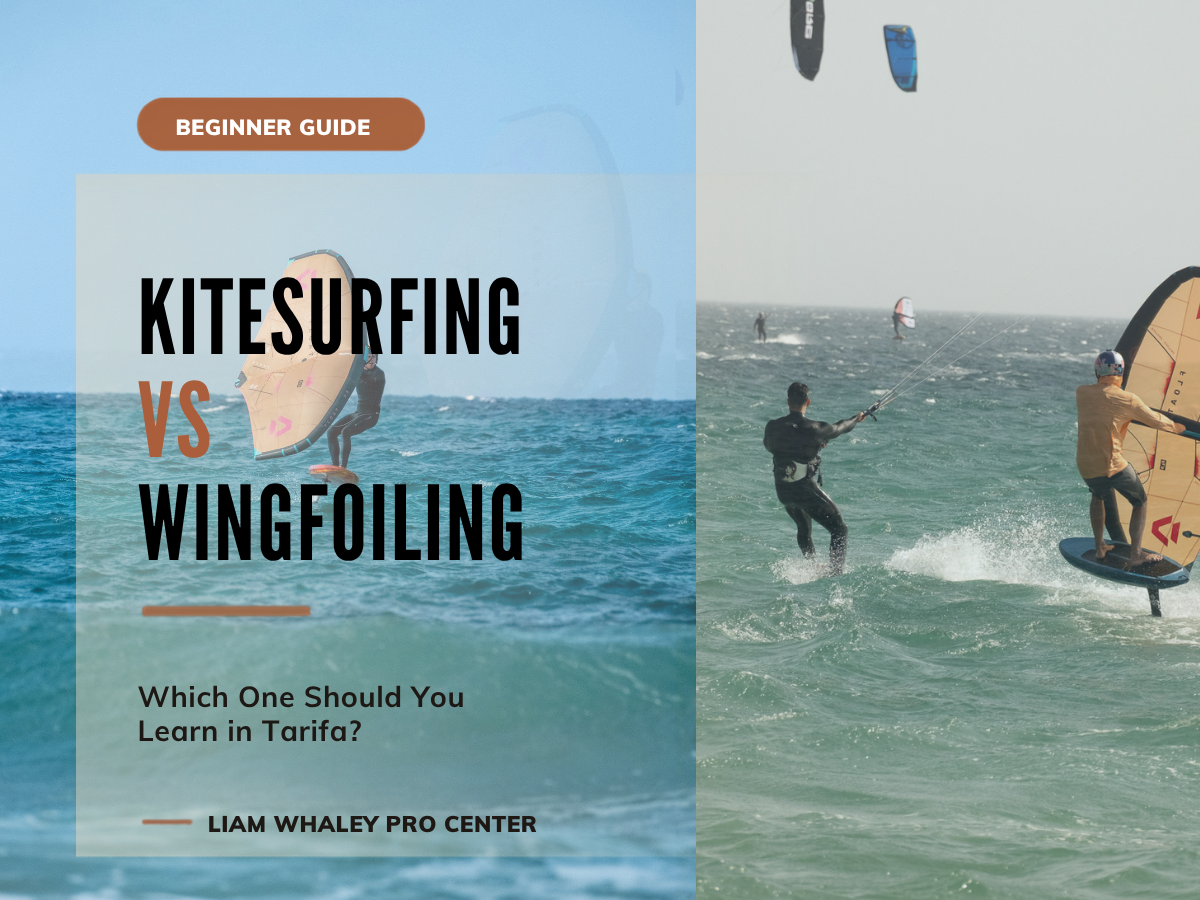
Kitesurfing vs Wingfoiling: Which Should You Learn in Tarifa?
At Liam Whaley Pro Center, wingfoiling is no longer a side conversation. Gastón, the Center Manager, estimates that it now makes up around one out of every three lessons. You can feel that shift in the questions visitors ask before they book.
A couple might arrive planning the same trip, but looking for different experiences on the water. One person has always wanted to fly a kite and feels drawn to the power, board riding and long progression toward jumps. The other sees a rider holding a wing close to their body, watching the foil lift quietly above the water, and feels that it looks less intimidating from the shore.
One family put it simply in their review:
“Kite lessons for our daughter and wingfoil courses for us.”
That is increasingly normal at the Pro Center: people can share the same Tarifa trip without needing to choose the same sport.
If you’re making that decision specifically for a child, our guide to kitesurfing or wingfoiling for kids in Tarifa looks at which one we tend to suggest first based on age, goals and conditions.
That first impression makes sense. A wing is in your hands rather than flying high above you, and foiling can open more time on the water when the wind is softer. It does not make wingfoil universally easier or safer, but it helps explain why some visitors feel more curious about trying it first. Friends can arrive with the same trip and leave with different first lessons in mind.
So which should you learn in Tarifa? There is no universal winner. Kitesurfing and wingfoiling ask for different things from a beginner, and the right first choice depends on what you want to feel, how confident you are in the water, how much time you have and the conditions during your trip. You do not need to choose the same sport as the person you travelled with. You only need a clear place to start.
Not sure which one fits your trip, your experience or your home spot? Call +34 681 286 516 or send the team a WhatsApp and we will help you choose between kitesurfing and wingfoiling before you book.
Is kitesurfing or wingfoiling easier to start?
At Liam Whaley Pro Center, we see it every day: wingfoiling is easier to learn than kitesurfing for most complete beginners. The pathway is more direct. You hold the wing in your hands, there are no long lines to manage, and the board already floats, so you can start moving before you even think about flying.
Many students start to find consistent wingfoil glides after around six hours of focused practice. Kitesurfing asks for more separate skills before you can ride independently: understanding the wind window, controlling the kite, body dragging, recovering the board, waterstarting and staying upwind. For that independent-rider assessment, most complete beginners should plan around 12–15 hours.
That does not mean wingfoiling is effortless. The foil creates its own hard stage once the board begins to lift; balance, height and speed all matter at once. But for most people, the early process involves fewer critical steps and less time feeling stuck. Kitesurfing is the sport where beginners tend to struggle more at the start. Wingfoiling is the quicker, more approachable way into wind sports, especially if your goal is to get moving, feel the glide and build confidence on the water.
What happens in your first hour of kitesurfing vs wingfoiling?
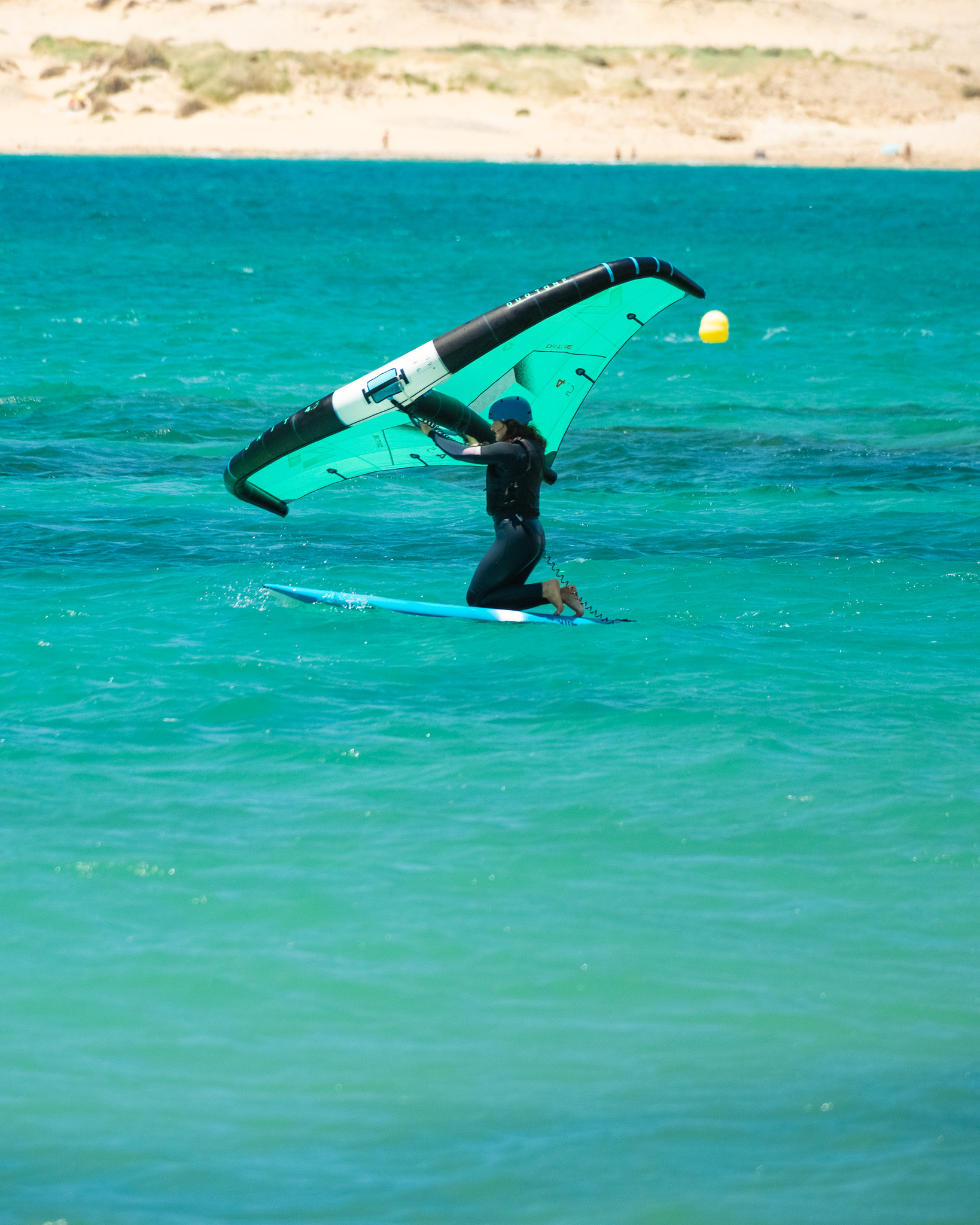
Both lessons begin with a short explanation on the sand. For wingfoil, that means understanding how to position the wing in the wind and control power with your hands. After that, the first hour looks very different.
In a first kitesurfing lesson in Tarifa, you stay close to the beach and learn the wind window, the safety system and how to steer the kite without fighting its power. The board is not the focus yet. Before you combine kite and board on the water, you need to understand where the kite pulls, how to release it and how to keep it under control.
In wingfoil lessons in Tarifa, you go straight into the water with the wing and board. You learn how to hold the wing, catch the wind and start moving on the board. You are not trying to foil yet (that comes later). The first goal is simply to feel comfortable with the wing in your hands and the board beneath your feet.
That is the first-hour difference: kitesurfing begins by learning to manage the kite, wingfoiling begins by moving on the water with the wing and board together.
When does each sport start to feel difficult?
Kitesurfing becomes more complex when you bring kite, board and water together. Body dragging, board recovery, water starts and eventually staying upwind ask you to manage the kite while your attention is also on the board and the water.
Wingfoiling becomes more demanding once the foil begins to lift. You are managing wing power, board balance, speed and the height of the foil at the same time. That is where a wing can feel wonderfully direct, but also where small changes in stance suddenly matter.
This is why the sport that looks less intimidating from the beach is not automatically the faster route to independence. The hard part simply arrives in a different place.
What does it cost to learn each sport until you can ride independently?
Both sports use the same lesson packages, so the clearest comparison is ten hours: five two-hour lessons. At current prices, that is €790 private, €638 semi-private or €395 group.
In kitesurfing, ten hours usually gets you to more reliable waterstarts, longer rides and the first stages of riding upwind. You may be close, but most beginners still need one or two more lessons to become independent. At the Pro Center, that means staying upwind, recovering your board and launching and landing safely, which is why the usual guide is 12–15 hours rather than a fixed package.
Wingfoil reaches its first milestone sooner. Many beginners start to feel consistent glides after around six focused hours, or roughly three lessons: €510 private, €428 semi-private or €250 group. By ten hours, you are usually working on longer glides and your first attempts to stay upwind. Wingfoil is the less expensive route to get moving, but neither sport has a guaranteed independence point. That depends on what you can repeat safely on the day.
What does it cost to own kitesurfing or wingfoil equipment?
To keep this comparison fair, use standard beginner equipment. No SLS and no Aluula. For kitesurfing, that means Duotone's Evo Entry Set: the original Dacron Evo kite, Gonzales board, Trust Bar, quick-release and bindings. A current European retail reference is around €2,200 before a harness and wetsuit. One all-round kite is enough at the start; a second size is usually a later upgrade for a wider wind range.
For wingfoil, the like-for-like setup is a Sky Start DST board, a standard Unit wing and beginner Lift foil in the Glass construction, not an SLS setup. Current European retail examples are around €1,399 for the board, €999 for the wing and €559 for the Lift front wing. The board and wing are only part of it: mast, fuselage, stabiliser, handles and safety gear still need to be added, so a complete standard wingfoil setup generally ends above €3,000.
These are European retail references, not official Duotone prices or a fixed Pro Center quote, so they vary by country, size and availability. Before you buy, our instructors can help you understand which setup makes sense for your weight, current level, the wind you expect to ride at home and the sizes that will give you a usable range. We do not sell equipment, but we do want you to leave Tarifa with a realistic idea of what your next step could cost. Once you can ride independently, you can also rent kitesurf equipment or wingfoil equipment and try different setups before you buy.
One of our students, Walter Simonazzi, put the value of that guidance neatly:
“His advice on choosing the right setup for the strong Levante was next-level.”
Learn first, then choose your own gear around your weight, level and the conditions you expect to ride in.
Do Tarifa’s conditions suit kitesurfing or wingfoiling better?
Kitesurfing needs at least 14 knots before most beginners can realistically start riding. With wingfoil, you can already be on the board, holding the wing and trying to move in much lighter wind. It is closer to a first windsurf session: you can float, balance and understand the power before you are ready to fly on the foil.
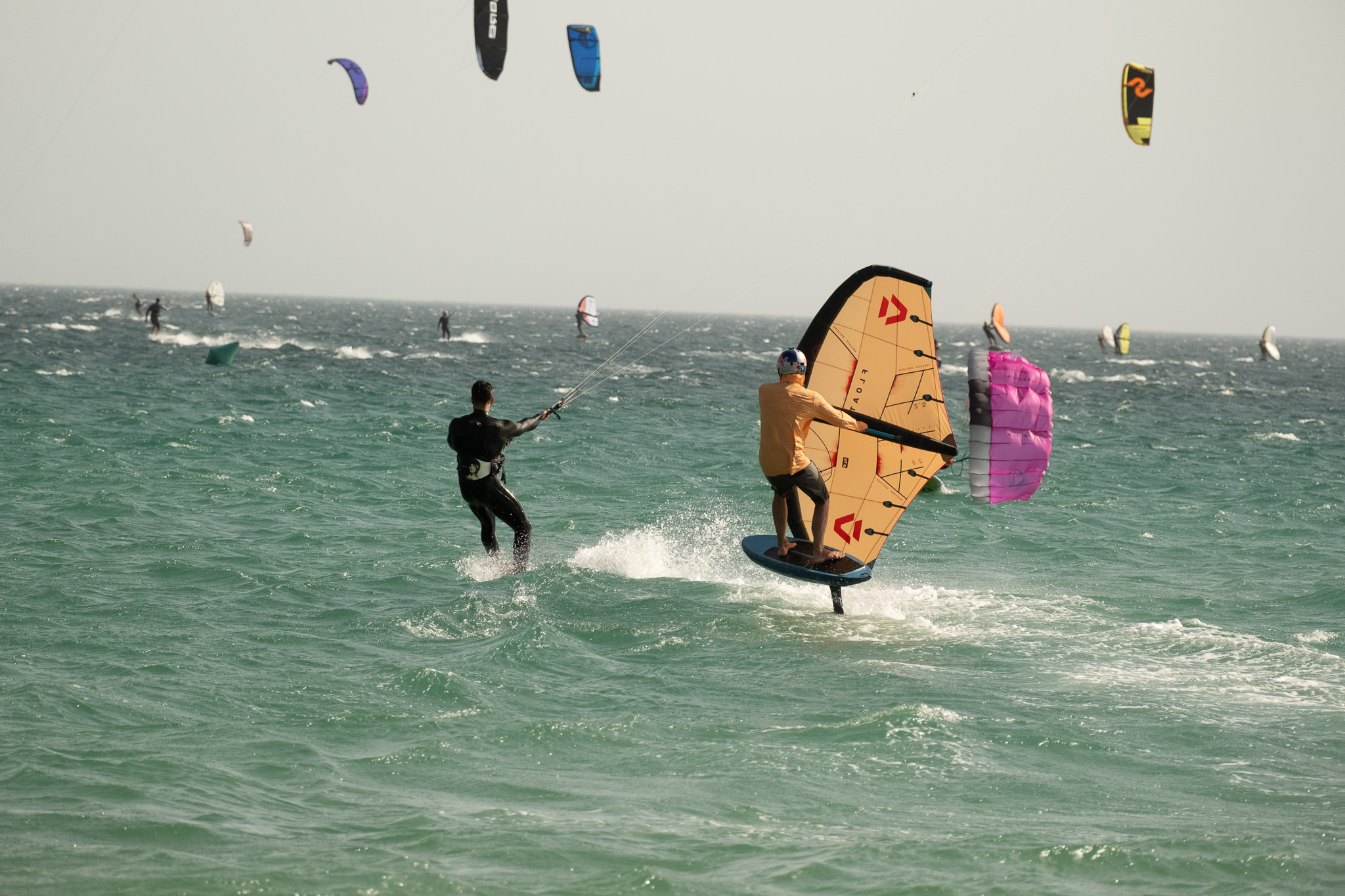
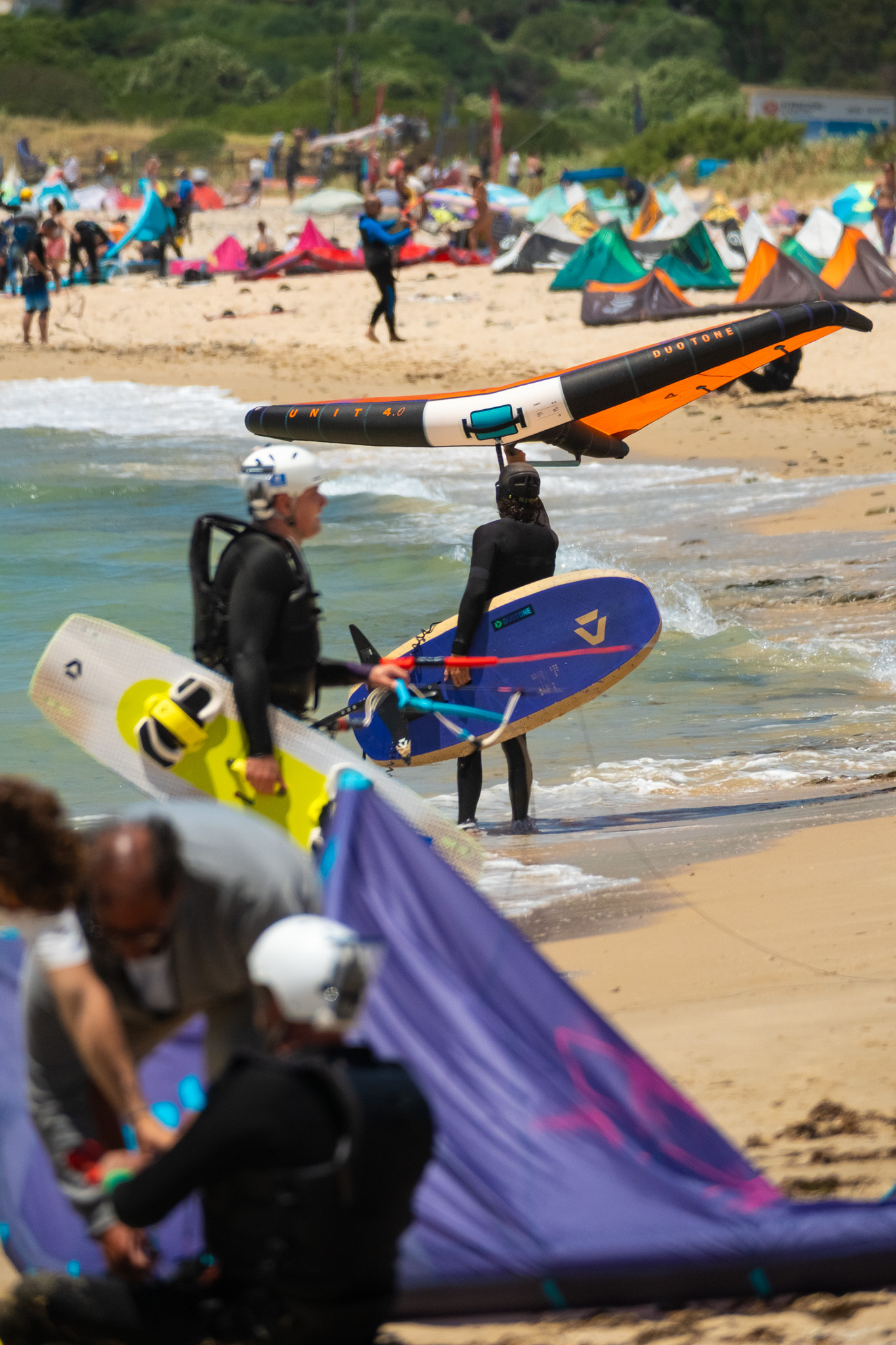
Valdevaqueros is not a shallow-water spot, which works well for both sports. But it can be busy. That is where wingfoil has a clear advantage: it takes less space on the beach. A kite needs a wide clear area for launching, landing and managing lines. With a wing in your hands, the setup feels more contained and less intimidating around other people.
Once you have enough control to lift onto the foil, wingfoil has another advantage here. You fly above the chop, so the board feels much smoother. On a twin-tip kiteboard, you are still riding through the Valdevaqueros chop. A kitefoil can give you that same smoother ride, but it adds another level of skill.
For Tarifa’s beach space and chop, wingfoil is usually the winner.
Which sport is safer to learn?
Neither sport is automatically safer. The safer choice is the one taught in the right conditions, with the right equipment and enough space to make mistakes without rushing.
Kitesurfing has more to manage at the beginning: a larger wind window, long lines, and a kite that can generate power quickly. That is why the first lessons focus so much on safety systems, kite control and understanding where the kite is in the wind window before you start riding. At the Pro Center, beginners learn in a dedicated zone with radio helmets, safety equipment and rescue support. Read more about why Tarifa can be beginner-friendly for kitesurfing.
Wingfoiling can feel calmer on the beach because the wing stays in your hands and there are no lines to manage. But once you start trying to foil, the board and foil introduce a different kind of risk. You need enough depth, room to fall, and control before trying to lift. That is why the early stages are kept simple: first move comfortably on the board, then build toward flying.
As Matteo puts it: “We have experienced instructors, radio helmet systems and a rescue-boat connection, so we can act quickly.”
The goal is not to make either sport look harmless… it is to make the first steps controlled, clear and appropriate for the day.
Which sport is more physically demanding?
Kitesurfing is usually more physically demanding at the beginning. You are learning to control power through the harness while moving in the water, body dragging, recovering the board and repeating water starts. The effort often comes in short, intense bursts… especially on a windy day in Tarifa.
Wingfoiling feels different. The wing itself is lighter and more direct to hold, but the work is more continuous once you are on the board: balance through your legs, core control and repeated attempts to find the right stance before the foil lifts. You may not feel as pulled as you do by a kite, but your legs can still get tired quickly.
That does not mean you need to be exceptionally fit for either sport. Instructors can adapt kite or wing size, board volume, lesson pace and conditions to your confidence and mobility. For more detail, read how fit you need to be to learn kitesurfing in Tarifa.
One student, Sofie V W, described the reality of early sessions well:
“I could spread them over the afternoon cause I was dead after one hour.”
It is normal to need breaks. The goal is not to push through fatigue, it is to learn while you can still stay focused and enjoy the water.
Who should choose kitesurfing, and who should choose wingfoiling?
Choose wingfoiling if you only have a few days in Tarifa and want the most direct route to getting on the water. It is also a strong choice if you are not sure you will be able to practise wind sports consistently during the rest of the year. You can make meaningful progress in a shorter trip, then come back the following season and usually reconnect with the wing and board without rebuilding every step from zero.
That makes wingfoiling a practical option for occasional riders. The wing stays in your hands, the setup takes less space, and the early movement pattern is relatively simple to revisit. It can also suit a home spot with gusty wind or a narrow beach, where managing kite lines and finding a wide launch area would be less comfortable. Private, semi-private and group wingfoil lessons can also change how quickly that first progress feels.
Wingfoiling is especially natural for windsurfers. If you enjoy riding, gliding above the water and eventually using small swell, rather than focusing mainly on jumps and freestyle, it may be the better fit.
Choose kitesurfing if you are happy to invest more time and build confidence step by step. Returning after a long break can mean revisiting kite control and safety before everything feels automatic again. But that patience opens a very broad progression.
With the right conditions, kitesurfing can also be easier to travel with and gives you a huge variety of disciplines to explore: surf riding, freestyle, wakeboarding-style riding, old school and big air. It is a great choice if your home spot has consistent wind, enough beach space to launch safely and an active kite community. For a patient rider, it can keep offering new directions for years.
Can you learn both sports during the same Tarifa trip?
Yes, but do not expect to master both at once. A first trip can be a good chance to try each sport and discover which feeling you want to pursue.
Start with the sport that matches your main goal. If you want a direct first experience on the water, begin with wingfoiling. If you came to Tarifa specifically to learn kite control, board riding and eventually jumps, give kitesurfing enough sessions to build real momentum.
Trying both can still make sense for couples, families or friends with different interests. You can share the same beach day while learning different sports. The useful outcome is not checking two sports off a list. It is leaving with a clearer sense of which one you want to continue.
Frequently asked questions about kitesurfing and wingfoiling in Tarifa
Which sport is easier to start: kitesurfing or wingfoiling? +
For most complete beginners, wingfoiling is easier to start. You can get on a floating board and begin moving with the wing in your hands early in the process.
Kitesurfing takes longer because you first need to build kite control, safety awareness and confidence before riding.
Which one is better if I only have a few days in Tarifa? +
Wingfoiling is usually the better choice for a short trip. It gives most beginners a more direct first experience on the water, so your time is spent building movement and balance rather than managing several separate kite skills.
Which sport makes more sense for my home spot? +
Wingfoiling often makes more sense if your home spot has gusty wind, limited beach space or no comfortable place to launch and land a kite.
Kitesurfing is a great fit when you have consistent wind, a wide beach and an active local kite community.
Which one should I choose if I already windsurf? +
Wingfoiling will usually feel more familiar. The wind-and-board relationship is easier to recognise, and the progression toward gliding above the water follows a more natural path for many windsurfers.
Which sport offers more long-term progression? +
Kitesurfing offers the broader range of disciplines: freeride, surf riding, freestyle, wakeboarding-style riding, old school and big air.
Wingfoiling has its own depth, especially for glide, swell and downwind riding, but kitesurfing is the better fit if variety, tricks and jumping are your main motivation.
Can I try both before I decide? +
Yes. Trying both can clarify what you enjoy, but if you want meaningful progress during one trip, keep most of your sessions focused on the sport you want to continue afterward.
Which lesson should you choose for your Tarifa trip?
Choose wingfoiling if you want the more direct first route onto the water, have limited time in Tarifa, prefer a compact setup or expect to ride at a spot with less beach space.
Choose kitesurfing if you are ready to invest more time at the beginning and want the broader long-term progression: surf riding, freestyle, old school, big air and more.
Ready to start? Book kitesurfing lessons in Tarifa if you are ready for the longer progression, or wingfoil lessons in Tarifa if you want the more direct first route onto the water.
Still not sure? Call +34 681 286 516 or send the team a WhatsApp. Tell us how many days you have, what you want to feel on the water and where you expect to ride at home. We will help you choose the lesson that fits.
Latest News
- Wingfoiling for Kids in Tarifa: What Parents Should Know Before Booking
- Kitesurfing or Wingfoiling for Kids in Tarifa: Which Should They Try First?
- What Will You Learn in Wingfoil Lessons in Tarifa? From Day One to Independent Riding
- Is Tarifa a Good Place to Learn Wingfoiling? What We Tell Beginners Before They Book
- What Happens in Your First Wingfoil Lesson in Tarifa? We Get Asked This a Lot
- Am I Too Old to Learn Kitesurfing at 50 or 60 in Tarifa?
- Is Tarifa a Good Place for Kids to Learn Kitesurfing? Age, Safety and What Parents Should Know
- Kitesurfing vs Wingfoiling: Which Should You Learn in Tarifa?
- Private, semi-private or group wingfoil lessons in Tarifa: which should you choose?
- How Fit Do You Need to Be to Learn Kitesurfing in Tarifa?