
When Should I Go to Tarifa to Learn Kitesurfing? A Month-by-Month Guide
We teach kitesurfing on Valdevaqueros beach, about 15 minutes' drive from Tarifa town, from around mid-March to early December. There's no perfect month to learn. Every month is different, and the right one for you depends on the trip you want and how you feel about a bit of cold or a busy beach.
If you want warm water and a town with a lot of nightlife, July and August are your months. Just book ahead. If you'd rather have space on the water and don't mind a thicker wetsuit, spring and autumn are great for learning. And if you've got kids and you can pick your dates, we'd go for June or September.
What's the best time to learn kitesurfing in Tarifa?
For most beginners we'd say May, June or September. The water's not as cold as early spring (around 17°C in May, 19°C in June and 21°C in September, compared to about 16°C in March and April), there's good wind, and the beach isn't packed. In June it's not full yet, and by September most of the summer crowd has gone home.
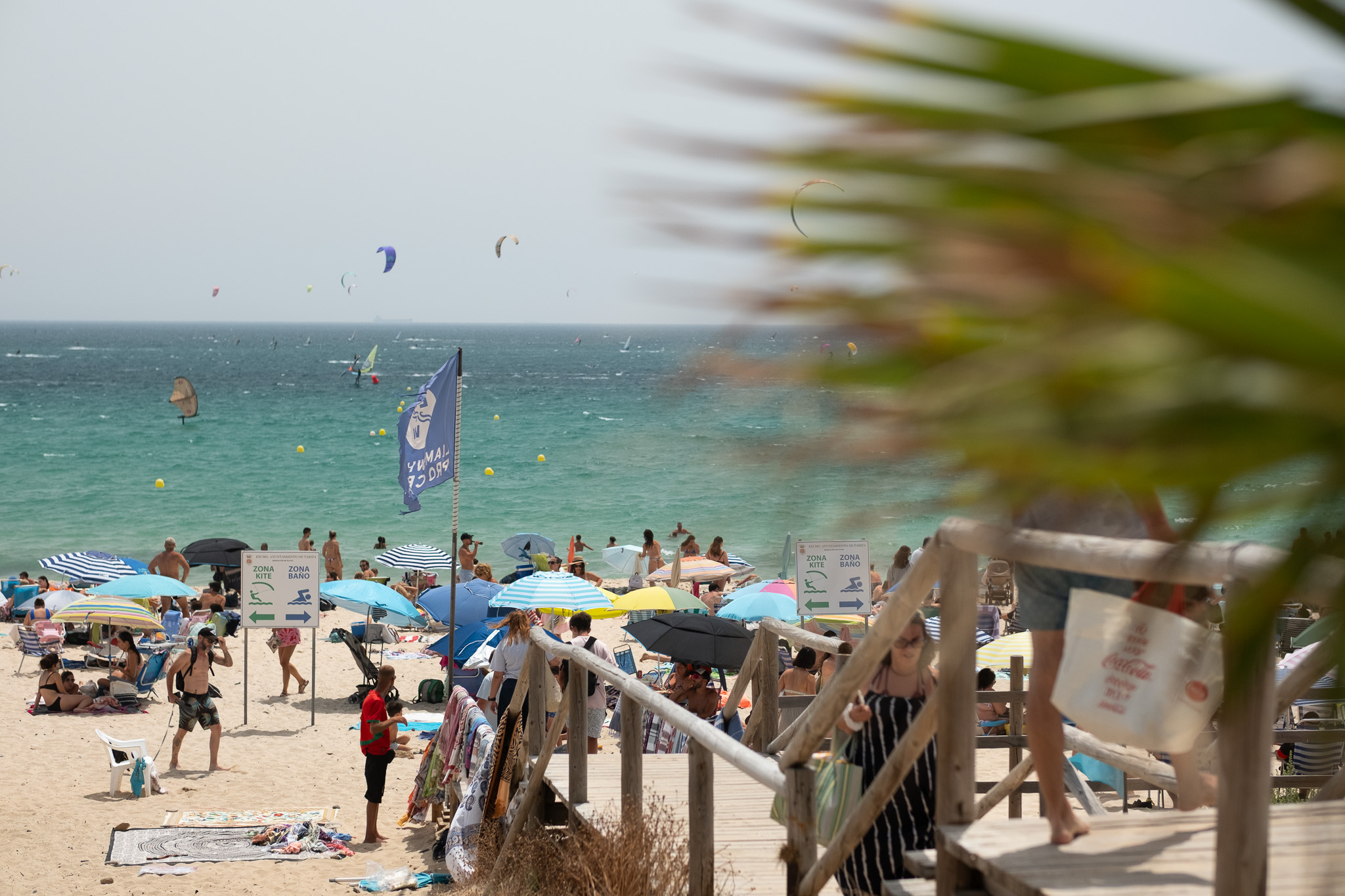
Cold or crowds. In spring and autumn the water’s colder, but there are far fewer kites on the water. In summer you can have 50 or 100 kites around you. In autumn it’s more like 15. When you’re learning, that makes a big difference. You drop the kite in the water, you get it back up in the air, and there’s nobody right next to you. It’s much less stressful.
Think of the kite as a sail on lines about 20 metres long. When you’re learning water starts, you have to move the kite through the air to get power, and that pulls you downwind and to the side. On a busy beach you’re also watching the people around you, trying not to tangle your lines with other kites, and sometimes waiting for someone to move before you can go. With wingfoil it’s different. The wing is in your hands and much smaller, so you need less space, and so does the person next to you.
Who's coming with you. Families mostly come in June, July and August, during the school holidays. In September, October and November it's more couples, people travelling on their own and small groups of friends.
What you want after your session. From June to September the town's busy at night (it's the busiest time of the year, and the Feria's in the second week of September), with beach bars, parties and summer events. From October it's a lot calmer, the evenings get cooler, and it's easy to find a table for dinner.
Whatever month you pick, leave a few days open for your lessons. The wind here can change a lot from one day to the next, so a week with some free days usually gives you more good sessions than three days you can’t move.
How do the months compare for a beginner?
| Month | What it's like for a beginner | Wetsuit | How busy | Town and prices | Good for |
|---|---|---|---|---|---|
| March
From around the 10th
|
Season starting, cold water, quiet beach (about 10 rainy days) | Full 4/3 (sea about 16°C) | Very quiet, busy around Semana Santa | Town opening again, cheaper places to stay | Learners who don't mind the cold |
| April | Mix of Levante and Poniente, mild days (about 9 rainy days) | Full 4/3 (sea about 16°C) | Quiet, apart from Semana Santa | Relaxed, good prices outside Easter week | Couples, solo learners, van travellers |
| May | Warmer days, still a quiet beach (about 7 rainy days) | Full 4/3 (sea about 17°C) | Quiet to moderate | Lively but not full | Most beginners |
| June | Summer starts, warm days (about 4 rainy days) | Full 4/3 (sea about 19°C) | Busier late in the month | Nightlife starts, prices rising | Families, most beginners |
| July | Strong Levante, warm, busy (about 1 rainy day) | Full 3/2 from mid-July (sea about 21°C) | Very busy | Full summer, highest prices | Families, groups of friends |
| August | Peak season (about 1 rainy day) | Full 3/2 (sea about 22°C) | Busiest month | Busiest town, highest prices | Families on school holidays |
| September | Still warm, quieter after the first half (about 4 rainy days) | 3/2, then 4/3 (sea about 21°C) | Moderate, then quiet | Feria, then calmer, prices drop | Beginners, couples, solo travellers |
| October | Fewer people, first rain (about 8 rainy days) | Full 4/3 | Quiet | Calm evenings, cheaper places to stay | Flexible learners, van travellers |
| November | Best week or worst week (about 11 rainy days) | Full 4/3 (sea about 18°C) | Very quiet | Quiet town, low prices | Flexible learners who can stay longer |
| Early December
To around the 10th
|
Last weeks, more winter weather (about 12 rainy days a month) | Full 4/3 (sea about 17°C) | Very quiet | Quiet, low prices | Learners with very flexible dates |
Monthly temperatures and rainy-day counts are approximate long-term climate averages, not daily forecasts. Wetsuit recommendations and lesson suitability depend on actual conditions.
We've got every type of wetsuit at the center, so you don't need to bring one. Our lesson prices are the same all year. What changes with the season is how much you pay for a place to stay and a rental car.
What changes from month to month in Tarifa?
There are two main winds here. Levante comes from the east. It's warm, dry, often strong and gusty (regularly 30 knots, about 55 km/h, or more in summer, and most months you'll get a few days at 35 to 40 knots). Gusty means the wind gets stronger, then weaker, then stronger again. At Valdevaqueros it blows a bit offshore, from the land out to sea. So if you drop the kite, the wind pushes you away from the beach, not back to it. That's why the rescue boat matters. Poniente comes from the west, off the sea. It's cooler, usually more consistent, and it often brings some waves with it. If you want to know what each one feels like on a lesson day, have a look at our guide to how Levante and Poniente change your kite lessons.
The water here is cool most of the year (about 16 to 18°C outside summer, and 21 to 22°C at its warmest from July to September). Tarifa's right on the Strait of Gibraltar, where the water's deep and cold. Drive an hour up the coast towards Cádiz and the sea can be a few degrees warmer (up to about 5°C). So unless it's the middle of summer, we'll usually put you in a 4/3. That's a thicker wetsuit, 4 mm on the body and 3 mm on the arms and legs. A 3/2 is the thinner summer one.
From mid-June to mid-September you can't kite on the beaches in Tarifa town. In summer you can only kite in marked zones on the bigger beaches, and Valdevaqueros, where we teach, is one of them.
Semana Santa, the Easter holiday week, moves every year. In 2027 it's from 21 to 28 March. That's when the season starts and the town fills up for a week. Our page on events and holidays in Tarifa has more on what's on through the year.
Whatever the month, we set up your lesson around you and the conditions on the day. On a strong Levante day that means a smaller kite and shorter lines (the lines connect you to the kite, and shorter ones make it pull less, so it's easier to handle). We don't teach Levante lessons without the rescue boat, and if the conditions are dangerous, we don't teach or rent at all.

What's spring like for learning kitesurfing in Tarifa?
Spring is quiet on the beach, the days get warm quickly, and the water stays cold. It's Liam's favourite time of year in Tarifa. He loves the mix of good weather, wind and not too many people, and he always says that if you're coming from somewhere like Germany, Holland or Belgium, this early warm weather is a great reason to come.
Spring can bring some rain too (around 9 or 10 rainy days a month in March and April), so keep a day or two spare. And if you can be flexible with your dates, checking the forecast a week or so before you come helps. For more on April to June, have a read of our guide to kitesurfing in Tarifa in spring.
What's it like to learn kitesurfing in Tarifa in March?
We usually open around the 10th of March. The date changes a bit each year, so send us a message to check when we're starting. The first few weeks are a quiet start. Everything's up and running, the instructors, the rental, the hot showers, but the beach is quiet and nobody is in a hurry.
The water's cold (about 16°C), so you'll be in a full 4/3, and the hot shower after your session is great.
In March, the town opens again. Restaurants and shops open for the season, and places to stay are still cheap. If Semana Santa is in late March, like it is in 2027, that week is very different. The processions fill the old town, it gets busy fast, and you'll want to book your room and your lessons ahead.
If you don't mind a bit of cold and you like having the beach almost to yourself, March is a great time to start.
Planning to learn kitesurfing in March?
Our season usually starts around mid-March, but the exact opening date can change. Send us your travel dates and we'll confirm when lessons are available.
Prefer to talk? Call us at +34 681 286 516.
Is April a good month to learn kitesurfing in Tarifa?
Yes, as long as you're happy in a 4/3. April's often warm enough for a T-shirt on land (average highs are around 18°C, but in the sun it feels a lot warmer), and over a week you'll usually get a mix of Levante and Poniente. The beach is quiet, apart from Semana Santa week if it's in April.
Rory came as a total beginner one April and left doing water starts, which means getting up on the board from the water and riding off:
"I had a great week as a beginner kitesurfer this April… I can now water start!"
Off the water, it's a relaxed month. The old town's easy to walk around, you won't need to book dinner, and outside Easter week you get good value on a place to stay. Spring sometimes brings some big events too, like Full Power Tarifa, a big air competition (think huge jumps) where some of the best riders in the world show what they can do.
It's a good month for couples, people learning on their own and anyone travelling around in a van who'd rather have room to practise than a busy town.
Is May a good month to learn kitesurfing in Tarifa?
May's one of our favourite months for beginners. The days are warmer (average highs around 20°C), the town's open and lively, and there's still space on the beach. The water's still cool (about 17°C), so stay with the 4/3.
You get most of the summer feeling without the summer prices. The beach bars are open, there's a lot going on in the evenings, and finding a place to stay is easy.
You don't usually need to book lessons far ahead in May. The only exception is a weekend with a good wind forecast, when it's worth sending us a message a few days before.
If you're starting from zero and want good weather without the summer crowd, May is a very good choice.
Is June a good time to learn kitesurfing in Tarifa?
June is when summer starts. It's warm (average highs around 24°C, sea about 19°C), there's more nightlife, and the summer kite zones start from mid-June. It's also the month we'd choose if you've got kids and can pick your dates. It's warm and the beach isn't full yet.
June's tuna season in Tarifa too. Restaurants make special tuna tapas, which is a good reason to eat well after a session. Places to stay get more expensive towards the end of the month, so book your room early if you're coming late June.
Early June is quieter than late June, because the summer crowd starts arriving towards the end of the month. June is also a good month for a short trip of three or four days. The weather is good and there are still fewer people than in July and August. With only a few days, try to keep them flexible, so one day with bad wind doesn’t take away a big part of your trip.
If you only have a few days and just want to try something, we often suggest wingfoil, because it’s easier to get started with in a short time. You hold the wing in your hands, there are no long lines, and you need less space. When you need a break, you can just let go of the wing. Our kitesurfing vs wingfoiling guide explains what learning each one is like.
Can you learn kitesurfing in Tarifa in July and August?
Yes, a lot of people learn with us in July and August. It's warm, the water is at its warmest, and the town's busy day and night. The one thing is, book ahead. July and August are the only months we fill up.
Be ready for strong wind and a lot of people on the beach. In July and August the Levante wind is often strong, around 30 knots, and our part of the beach gets busy. The beach also isn’t very wide, and until mid-September part of it is kept for swimmers.
On a strong Levante day we change how your lesson works. Normally you spend some time flying the kite on the sand first. When the wind is very strong, the kite pulls a lot harder on land, and with people walking around, that isn’t the best place to learn.
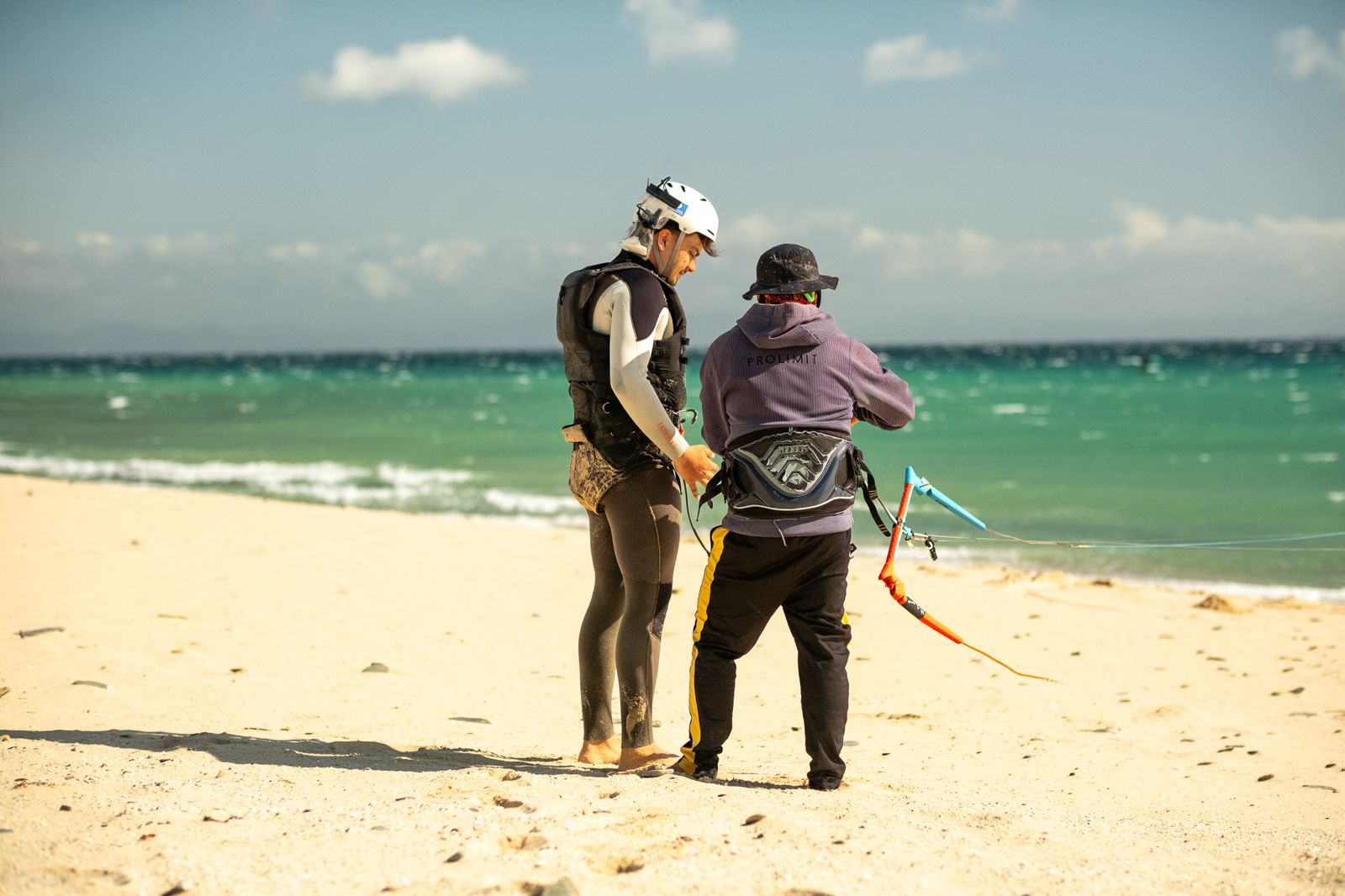
So we start with the safety talk on the beach. Your instructor explains where the wind comes from, how the kite moves and how to stop it if something goes wrong, and sets up the lines with you. Then you go into the water together. Your instructor stays right next to you, attached to you, and helps you steer the kite. You learn the same things you would on the sand, but with more space around you and less risk.
You also wear a helmet with a radio, so your instructor can talk to you while you’re on the water, and the rescue boat is out in case you need help.
A few days a month the wind is just too strong for a first lesson. On those days we’ll tell you and move your lesson to a better time or day.
What's July like for a beginner?
July often brings strong Levante, around 30 knots (about 55 km/h). That's a lot for a first lesson, so on those days we start with the safety talk on the beach, then go into the water with you. Your instructor stays right next to you, and the rescue boat is out.
To give you an idea of the summer wind: Anton spent ten days with us one summer. He was still a beginner but could already ride, so he brought his own 11 m² kite (a mid-size kite: a small one is around 6 m², a big one around 17 m²). The wind was so strong that his kite was too big for most of his trip, so he left it packed and rented smaller kites from us for the ten days instead. He wrote:
“My 11m2 was mostly kept safely packed with winds between 30 and 40 knots for more than a week.”
When Poniente blows on a hot day, it often gets stronger through the afternoon as the land heats up (a forecast of 10 knots can end up at 18 to 20 by around 2pm). So lessons can start around 2pm instead of the morning, and if the wind's late we'll message you to change the time.
From around mid-July you'll switch to a full 3/2. For lessons, we prefer to give you this over a shorty, because a full suit protects you from the sun and if you hit the board.
July's full summer in town (average highs around 27°C, sea about 21°C). Beach bars are full at sunset, there's music and nightlife most nights, and summer's when the pro competitions come to Tarifa: big air, freestyle (tricks), wingfoil and more. Watching the best riders in the world from the beach is special after your own lesson. Places to stay and rental cars are most expensive, so book them early.
July's great for families on school holidays and groups of friends who want a busy, fun summer holiday.
What's August like for a beginner?
August’s the busiest month, on the beach and in town. It’s mostly families on school holidays, plus groups of friends who want to go out at night. The water’s at its warmest (about 22°C), so you’ll be fine in a 3/2.
You’ll be sharing the water with a lot of other kites, so how we set up your lesson and having the rescue boat out make a big difference.
If the crowds worry you, August is a good time to try wingfoil instead. The wing is small and you hold it in your hands, so you need much less space than with a kite, and it’s easier to get started with. You can book wingfoil lessons in Tarifa with us too. You'll enjoy it more.
Off the water, Tarifa is very busy: busy beaches, almost impossible to park in town, late dinners and a lot of good parties. It’s the most fun month if you want a lively holiday, and the most expensive one too.
If school holidays decide your dates, August works fine. If you can choose, a month before or after gives you more space.
Is autumn a good time to learn kitesurfing in Tarifa?
In autumn the beach is much quieter. It's great for learning if you don't mind the cold and can stay flexible. From October you'll start getting some rain (on average about 8 rainy days in October and 11 in November), and when it rains there's usually no wind.
Is September a good month to learn kitesurfing in Tarifa?
Yes, it's one of the best months to start. The first half still feels like summer, with warm days around 25 to 30°C (sea about 21°C, and only around 4 rainy days), and the beach gets quieter as the month goes on. The summer kite zones finish in mid-September, so there's more room on the water. Matteo, our instructor manager, often recommends September to people starting from zero, people travelling on their own and couples.
It's also when a lot of people who can't get away in summer come to Tarifa. Matteo remembers a couple who work in tourism and couldn't take time off in August. So they came for ten days in September and started kitesurfing from zero.
A full 3/2 is fine for the first half of the month. Later on, or if you get cold easily, a 4/3's more comfortable.
Janwillem spent a week learning with us one September:
"Had an awesome experience this past September. With a full week of lessons when the weather allowed it."
In town, the second week of September is the Feria, Tarifa's big summer fair, with music, food and a fairground. After that it gets calmer. Some beach bars start closing a bit earlier towards the end of the month, but they're still open. Places to stay and rental cars get cheaper after August, while restaurants cost about the same. Our guide to learning in Tarifa in September has the details and more student stories.
What's October like for learning kitesurfing in Tarifa?
There are very few kites on the water in October (often around 15, compared to 50 to 100 on a summer day), so you get a lot of time with your instructor. You'll be back in a 4/3. With the wind and the cooler air it feels a lot colder than summer, and the hot shower after a session matters again.
October is also when the rain starts. On rainy days there's usually no wind, so a week in October might include a few days off the water. Come with a bit of patience and have a plan for the rainy days. And if your dates can move, have a look at the forecast before you come too.
The town's a lot calmer now. There are fewer parties, the evenings get cooler, and you'll find a table anywhere. Places to stay are much cheaper than in summer, so you might be able to stay longer for the same money.
October's good for flexible learners who'd rather have space than sunshine every day.
Is November worth it for learning kitesurfing in Tarifa?
November can give you the best week of the year or the worst. You might get wind every day, sunshine and an empty beach. Or you might get a few days of rain (November averages about 11 rainy days), cloud and no wind when a storm passes. If there's no storm around, there's usually wind.
If you choose November, stay longer than you would in summer and keep most of your days free for lessons. If you've got a bit of flexibility, it's also worth checking the forecast about 10 days before you come, so you can see if any storms are coming.
People who get a good November love it. Jens spent a whole November in Tarifa doing big air lessons with us, and wrote:
"Even during the month of November, this is the place to be!"
The town is quiet and local in November. Restaurants and cafés are open, there's no rush for anything, and places to stay are cheap. If you want a calm trip with time to explore, you'll like it.
Can you still learn kitesurfing in Tarifa in early December?
Yes, until we close around the 10th of December. The weather starts to feel like winter: more storms, stronger Poniente blowing onshore (from the sea towards the beach, which brings bigger waves in), and colder water (about 17°C). Shorebreak (waves breaking right on the sand) makes getting in and out of the water harder when you're just starting.
The town is quiet and cheap, and more places stay open into the winter than before. Early December works if your dates are very flexible. Message us before you book and we'll tell you what the forecast looks like.
We can only come in July or August with the kids. Can they still learn kitesurfing in Tarifa?
If school holidays decide when you travel, July and August it is. Kids learn here every summer, so it can work well.
Summer at Valdevaqueros means strong Levante days and a busy beach. Kids are lighter than adults, so a strong gust pulls them harder, and a busy beach means more to watch out for. That's why we usually suggest private lessons for kids (just your child and the instructor). The instructor focuses only on them, chooses the setup for their weight, and decides on the day if the wind is right for them.
Thomas came for a week with his kids, who were 13 and 14 and had never kited before:
"Our children (13 and 14) had their first kite surfing experience and are now hooked thanks to the amazing instruction of the team. The rescue boat team were critical to make it a safe learning environment."
Most kids start kitesurfing at around 12, but it's not a fixed rule. We look at how confident they are in the water and how much they weigh, because they need to be heavy enough to hold the smallest kite in Tarifa's wind. Our guide on kitesurfing lessons for kids in Tarifa explains more. If they're too young or too light for kiting, wingfoil can be a good way to start. Our guide to kitesurfing or wingfoiling for kids helps you choose.
If you've got kids of a similar weight, they can sometimes learn together. On a strong day we'll split them up.
A couple of tips for a summer family trip:
-
Plan a week if you can, with lessons spread over a few days rather than everything on one day.
-
Have a plan for the rest of the family on windy days and days with no wind. Our guide to things to do in Tarifa has ideas.
If you can move your dates at all, try June or September instead. It's still warm, with a lot fewer people.
I feel the cold. Is October or November still worth it for learning to kitesurf in Tarifa?
It can be, if you know what to expect. Autumn, like spring, brings a lot of travellers from northern Europe. Some drive down in their own vans and stay for weeks, some are digital nomads working from Tarifa, and some just take their holidays after summer.
We also see a lot of people who came for a summer or two, loved it, and now come earlier or later to avoid the crowds. This is very common. Once you've seen Tarifa in August, a quiet October beach feels like a different place. And every year more people stay on in the quieter months, so the town doesn't feel empty.
A lot of people who come on their own end up spending time at the center between sessions and getting to know other riders. That's the kind of place we like the center to be.
In October and November you'll be in a full 4/3, and we have one for you, so just bring a warm jacket for the beach between sessions. With far fewer kites around, you learn with a lot less pressure, and the hot shower at the center feels great after a cold session. The main risk is rain, so leave a few spare days in your trip.
If you feel the cold, private (just you and the instructor) or semi-private lessons (you and one other person) can suit you better than a group. You spend less time standing in the wind waiting for your turn. Our page on kite lesson formats explains the difference.
Places to stay and car hire are cheaper in autumn, so you can stay longer for the same money.
How far ahead should you book, and how many days should you stay?
Book ahead for July and August. They're the only months lessons fill up. Semana Santa week also fills up fast. The rest of the season you don't usually need to book far ahead, unless it's a weekend with a good wind forecast. Then just send us a message a few days before.
If you can, give yourself a week. You get more chances to go out when the wind and water are right for you, and you don't need to worry about every forecast. Three or four days can work in June or September if you're flexible. In October, November and early December, add a few extra days because of the rain. If you're wondering how far you'll get in a week, our guide to how long it takes to learn kitesurfing explains the stages.
If your dates can move a bit, there's another thing you can do outside summer: check the forecast before you come. You can see around 10 days ahead, which gives you a good idea of what's coming, so you can plan your trip around it. Look at the rain as well as the wind. If there's no rain or storm coming, it will most likely be windy. The further ahead you look, the less exact it gets, so the last few days are less certain. Our guide to reading Windguru for kite lessons in Tarifa (the forecast website most kiters here use) shows you what to look for.
Ties and his friends came for a week when the wind was light, and still got their lessons:
"Thanks to him, during a week with little wind, we still got out on the water at the right moments to learn to kite."
Translated from Dutch.
For flights, where to stay and getting around, have a look at our Tarifa trip planning guide. There's no bus to Valdevaqueros, so you'll need a car or a taxi.
What else do beginners ask about the Tarifa season?
Is Tarifa windy all year? +
There's usually wind during our season (Tarifa averages around 12 knots over the whole year with gusts near 19, and that includes the calm days), from Levante or Poniente. You'll still get days with no wind, and they're more common in autumn when storms pass.
Is Tarifa too windy for beginners? +
Some days it is, and on those days we don't teach. On strong days we use smaller kites, shorter lines and the rescue boat. Many first-timers learn here. And if you learn in Tarifa, you can kite almost anywhere.
What happens if there's no wind during my lessons? +
We'll always try to make the lesson happen first. If it's too windy in the morning, we might move you to later when it drops a bit. If it's light, we'll wait for it to get stronger or move you to another time or day. If we can't reschedule because you're going home or you've got other plans, we give you your money back.
Dominic liked how that worked for him:
"Matteo would call/message on the day and say if it was worth coming or better to delay a few hours to save me a wasted trip."
For ideas on days off the water, have a look at our guide to things to do in Tarifa on no-wind days.
Are kitesurfing lessons cheaper in low season? +
Not the lessons. Our prices are the same all year. Places to stay and car hire are cheaper outside July and August, but restaurants cost about the same. See our current lesson prices.
Do I need to bring my own wetsuit? +
No. We've got wetsuits for every month: 4/3, 3/2, full length and shorty.
Can you learn kitesurfing in Tarifa in January or February? +
Not with us. We close for the winter, usually from around mid-December until early March. You can still get in touch from January to plan your trip and book, and we start teaching again in March.
Which month suits you, and how do you book?
Pick the month that fits your trip, the people you're coming with and how you feel about the cold. If you're not sure, ask us.
Ready to plan your kitesurfing trip to Tarifa?
Send us your travel dates and we'll help you understand what to expect from the wind and conditions that week. You can also explore our lessons or book your sessions directly.
Prefer to talk? Call us at +34 681 286 516.
KEEP EXPLORING
Related guides for planning your kitesurfing trip to Tarifa
Spring in Tarifa
Tarifa in Spring for Kitesurfing: What to Expect in April, May and June →
Explore spring wind conditions, water temperatures, beach activity and what makes April, May and June different for a learning trip.
September conditions
Is September a Good Month to Learn Kitesurfing or Wingfoiling in Tarifa? →
See what September offers beginners, from warmer water and quieter beaches to wind conditions and planning lessons after summer.
Understanding the wind
Levante vs Poniente for Kitesurf Lessons in Tarifa →
Understand how Tarifa's two main winds affect gusts, water conditions, kite control and beginner lessons at Valdevaqueros.
Planning your holiday
Planning a Kitesurfing Trip to Tarifa: Flights, Transport, Forecast, and the Week Around It →
Plan your journey, accommodation, transport to Valdevaqueros and lesson schedule around your time in Tarifa.
Reading the forecast
How to Read Windguru for Kitesurf Lessons in Tarifa →
Learn how to interpret wind speed, gusts, direction and forecast changes before planning your sessions.
Latest News
- When Should I Go to Tarifa to Learn Kitesurfing? A Month-by-Month Guide
- Levante vs Poniente for Wingfoil Lessons in Tarifa
- Levante vs Poniente for Kitesurf Lessons in Tarifa
- Is September a Good Month to Learn Kitesurfing or Wingfoiling in Tarifa?
- Am I Ready to Rent Kitesurfing Gear in Tarifa? (Or Do I Need More Lessons?)
- Wingfoiling for Kids in Tarifa: What Parents Should Know Before Booking
- Kitesurfing or Wingfoiling for Kids in Tarifa: Which Should They Try First?
- What Will You Learn in Wingfoil Lessons in Tarifa? From Day One to Independent Riding
- Is Tarifa a Good Place to Learn Wingfoiling? What We Tell Beginners Before They Book
- What Happens in Your First Wingfoil Lesson in Tarifa? We Get Asked This a Lot