What Happens in Your First Wingfoil Lesson in Tarifa? We Get Asked This a Lot
Most people who book their first wingfoil lesson in Tarifa arrive with a rough idea of what wingfoiling looks like, but not much idea of what their first couple of hours will actually feel like.
You have probably seen the videos. Someone picks up speed, the board lifts out of the water, everything goes quiet, and suddenly they are flying.
That is where you are heading. But your first lesson is about building the foundations that eventually get you there.
You learn how the wing works. You start reading the wind. You find your balance on a big, stable board. And then comes one of the best moments of the first session: the wing fills with wind, the board starts moving, and for the first time you realise the wind is actually carrying you across the water.
You might not be flying yet.
But that first glide is when wingfoiling starts to make sense.
Here is what to expect.
Ready for your first wingfoil lesson?
Book your session, ask us a question, or explore our other lessons in Tarifa.
Prefer to talk? Call us at +34 681 286 516.
What happens when you arrive for your first wingfoil lesson?
You arrive at the center, check in at reception and meet your instructor.
The first job is choosing the right equipment for you and for the conditions that day: your wing, board, foil, wetsuit and impact vest.
And the learning starts immediately.
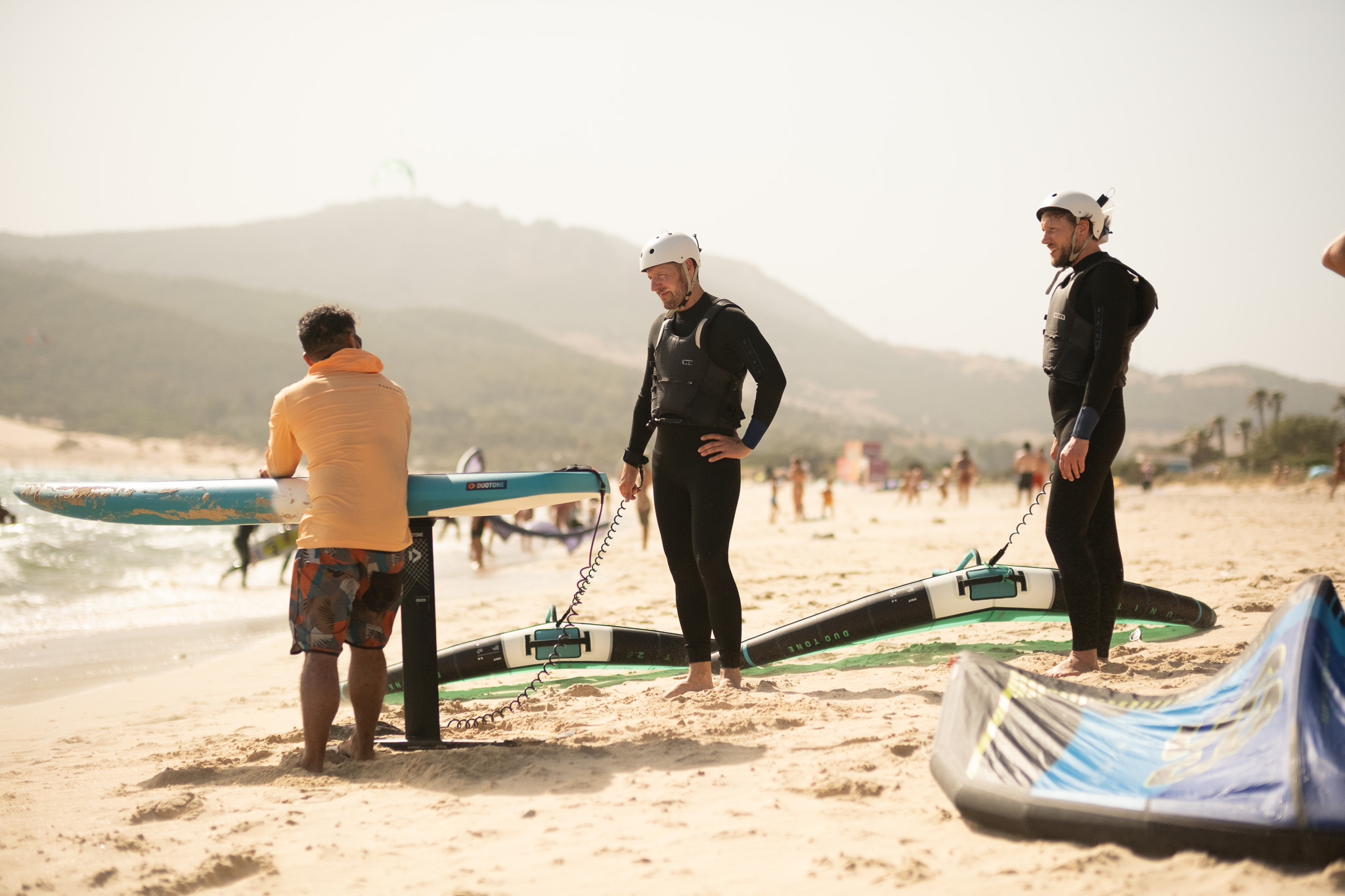
Rather than having everything prepared for you, your instructor gets you involved with the equipment. You inflate the wing yourself and start understanding what you are actually going to be using.
That matters. Once you are on the water, you are the one controlling it.
Then you learn how to carry everything properly and head down to the beach with your instructor.
Read Also: Should I choose a private, semi-private or group lesson?
Do you go straight into the water in your first wingfoil lesson?
No.
Before adding an unstable board and moving water to the equation, you need to understand the wing.
So the first part of your lesson happens on the beach.
Your instructor shows you where the wind is coming from and how to position yourself in relation to it. You learn how to hold and move the wing, how to generate more or less power, how your body should be positioned and how the wing can eventually take you downwind or help you work your way back upwind.
You will also go through the movements you are going to use on the water.
Think of it as a simulation.
On the beach, you can concentrate entirely on the wing. Once you get onto the board, your brain is going to have something else to think about: balance.
What happens when you finally get on the water?
Your first board is deliberately big.
You want something with plenty of volume and flotation, because the goal isn't to make your first session harder than it needs to be. A stable board lets you concentrate on your body position and the wing instead of spending the entire lesson trying to stay above water.
Your instructor will stay close while you find your position, get the wing under control and start moving.
At first, the distances are short.
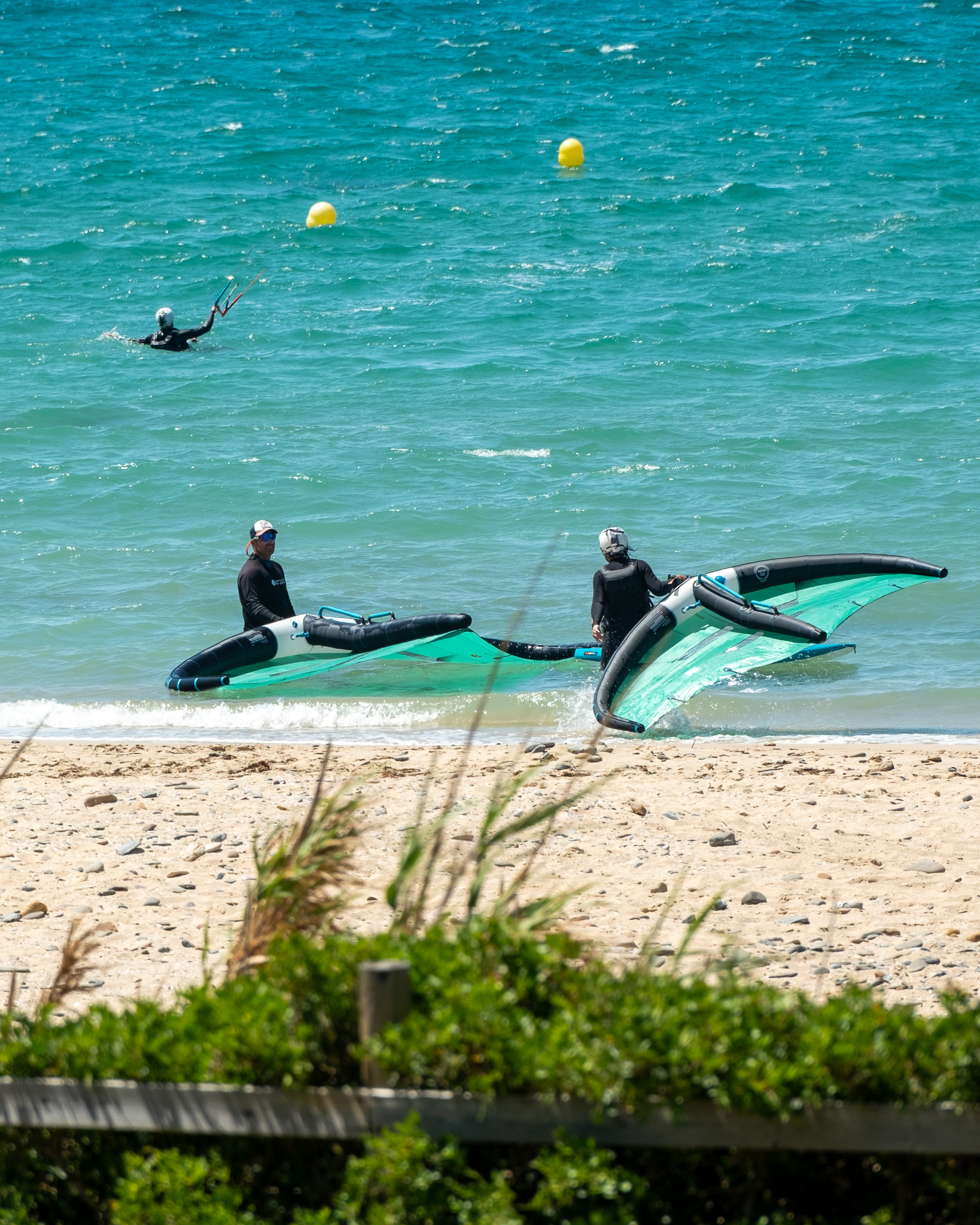
You might travel ten metres, come back towards the beach and gradually drift downwind. After twenty or thirty metres, you get out, walk back upwind along the beach with your instructor and equipment, and try again.
Then you repeat it.
And each run starts feeling slightly different.
You understand the wing a little better. You correct your stance. You stay balanced for longer. You start noticing where the wind is without having to think about it quite so much.
Those small improvements are what the first lesson is really about.
The same progression can be adapted for younger learners. If you’re planning a lesson for your child, read our Wingfoiling for Kids in Tarifa guide for the additional considerations around age, swimming ability, equipment and conditions.
What does your first wingfoil lesson actually feel like?
This might be the part nobody really tells you about.
Your first wingfoil lesson requires enough concentration that, for an hour or two, there isn't much room in your head for anything else.
You're feeling the pressure of the wind in the wing. You're thinking about your feet. You're adjusting your body position. You're trying to balance while noticing what the board is doing underneath you.
If your attention wanders, the wind lets you know pretty quickly.
So you become very present.
For that hour or two, it's you, the wind, the board, the sea and your body.
And despite how much you are learning, the atmosphere is usually surprisingly calm. There is time to talk with your instructor, laugh when an attempt goes wrong, walk back up the beach together and try again.
It's not necessarily an adrenaline-filled first session.
It's more a feeling of being completely absorbed in what you're doing.
And on a sunny day in Tarifa, out on the water with nothing else demanding your attention, that can be one of the best parts of learning.
What's the moment people remember most from their first wingfoil lesson?
It isn't necessarily flying.
Often, it's the first time you stand on the board, position the wing correctly and suddenly feel it fill with wind.
Until that moment, you've been learning individual pieces.
Where is the wind coming from?
Where should my feet go?
What should I do with my hands?
How do I keep my balance?
Then the wing powers up and the board starts moving.
The wind is carrying you.
You may only travel a short distance. The board may still be completely on the water. You probably won't look anything like the people in the videos yet.
It doesn't matter.
For the first time, you are not just practising wingfoiling. You are actually experiencing how it works.
That's a pretty good moment.
Will you fly on the foil during your first lesson?
Maybe, but it shouldn't be how you measure the success of your first lesson.
Wingfoiling has a progression for a reason.
Before you can comfortably ride on the foil, you need balance, wing control, body position and enough control over your direction and speed.
Some students progress faster than others. Previous experience in wind or board sports can help. The conditions on the day matter too, as Levante and Poniente can affect your first wingfoil flights differently.
But rushing towards the foil before the foundations are there normally makes everything harder.
Your first objective is control.
Flight comes afterwards.
If you want to see what comes next, our wingfoil progression in Tarifa guide follows the full path from wing control and first rides to staying upwind, controlled foil flights, turns and independent riding.
Is wingfoiling difficult to learn?
There is a learning curve, but one of the biggest mistakes is trying to skip it.
A good wingfoil course builds one skill on top of another.
First you understand the wing. Then you add balance. Then direction and speed. Eventually, you add the foil.
And when something stops working, sometimes the fastest way forward is actually to go backwards.
If you're falling repeatedly, for example, doing the same thing another twenty times might not be the answer. Maybe you need to spend more time on your balance.
If you're constantly fighting the wing, go back to wing control.
Get the foundation right and then build on top of it.
That's why the first lesson is structured the way it is: step by step, with each new challenge added when you're ready for it.
What should you focus on instead of trying to fly straight away?
The small wins.
Feeling where the wind is coming from without having to look around.
Holding the wing without fighting against it.
Standing comfortably on the board.
Travelling twenty metres farther than you did on your previous attempt.
Starting to choose where you're going instead of simply being taken downwind.
And, perhaps most importantly, enjoying the process.
There will always be another skill to learn in wingfoiling. If your only objective is the next milestone, you miss quite a lot of what makes learning it fun in the first place.
What's the best advice before your first wingfoil lesson in Tarifa?
Go step by step.
Don't arrive expecting to master wingfoiling in an afternoon, and don't get frustrated if something takes longer than you expected.
Build the foundations.
Listen to your instructor. Pay attention to the wind. Work on your balance. If something isn't working, go back one step and figure out why.
And enjoy those first small breakthroughs.
Because before the long foil rides and the turns and all the things you might eventually want to learn, there is a much simpler moment:
You're standing on a board in Tarifa.
You move the wing into position.
It fills with wind.
And suddenly the board starts moving underneath you.
For the first time, you stop fighting the wind and start moving with it.
That's your first real taste of wingfoiling.
How does your first wingfoil lesson change depending on the lesson format?
The basic progression is similar whichever format you choose: you learn how to control the wing on the beach, then take those skills onto a big, stable board on the water.
What changes is the rhythm of the lesson.
In a private lesson, every attempt is yours. Your instructor can watch what happens, give you a correction and let you try again straight away. That makes it easier to spend extra time on whatever you’re struggling with, whether that’s balance, wing control or simply feeling comfortable on the water.
In a semi-private lesson, you share the instructor and equipment with one other person. You get less time physically on the board, but you also get to watch their attempts, hear the instructor’s feedback and try to apply it when it’s your turn. It works particularly well when you're both starting from a similar level.
In a group lesson, the first experience becomes more social. You take turns, watch each other learn and share the falls and small wins together. You’ll naturally have less individual practice and one-to-one feedback, but for friends or families who want to discover wingfoiling together, that shared experience can be part of the fun.
So the steps of your first wingfoil lesson don’t change dramatically. What changes is how much you practise, how often you receive individual feedback and how much of the experience you share with someone else.
Want to understand the differences in more detail? Read our guide to private, semi-private and group wingfoil lessons in Tarifa →
Frequently asked questions
Do I need to know how to swim to try wingfoiling? +
Yes. You should know how to swim and feel comfortable in the water. Falling in is a normal part of learning, even though you’ll wear the appropriate safety equipment during your lesson.
Do I need kitesurfing or windsurfing experience before learning wingfoil? +
No. You can learn wingfoiling with no previous wind or board-sport experience. Kitesurfing, windsurfing, surfing or other board sports can make some parts easier, but they aren’t required.
How long is a first wingfoil lesson in Tarifa? +
A first wingfoil lesson usually lasts around 1.5 to 2 hours. This gives you time to learn wing control and wind basics on the beach before practising balance and board control on the water.
Will I fly on the foil during my first wingfoil lesson? +
Maybe, but it shouldn’t be your main goal. Your first lesson is about building the foundations: controlling the wing, finding your balance and learning to use the wind to move across the water. Flying comes once those skills start working together.
Is wingfoiling difficult to learn? +
Wingfoiling has a learning curve, but learning step by step makes it much easier. Good wing control, balance and body position are the foundations you need before progressing to riding on the foil.
Can I take my first wingfoil lesson with a friend? +
Yes. Two beginners can learn together in a semi-private lesson. If you want the instructor’s full attention or you and your friend are at different levels, a private lesson may be a better option.
What will you remember from your first wingfoil lesson in Tarifa?
Probably not how many metres you travelled or how many times you fell.
What you’ll remember is the first time things start to click.
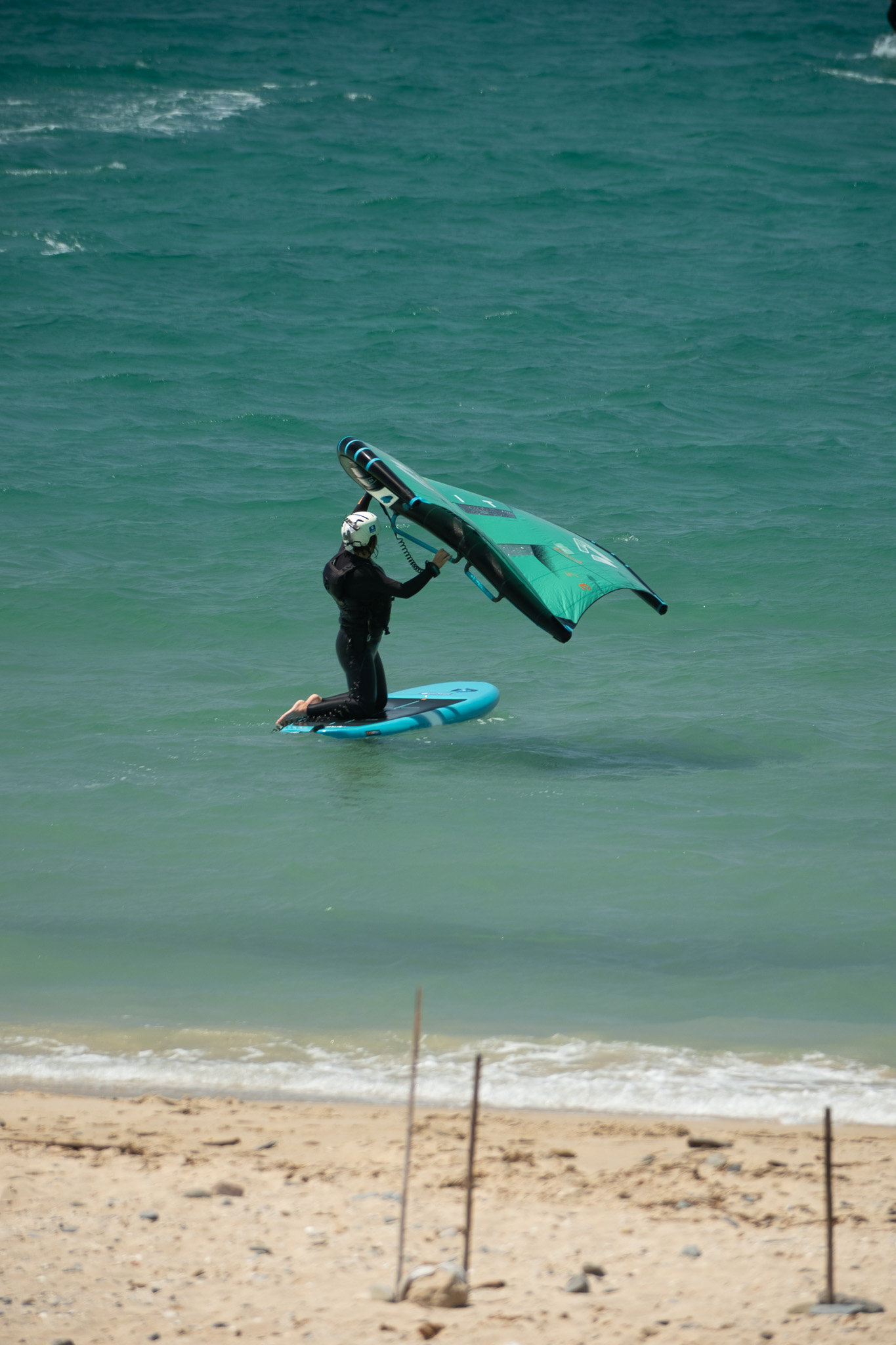
You’re standing on the board, trying to find your balance. You position the wing correctly and suddenly it fills with wind. The board starts moving and, for the first time, you feel the wind carrying you across the water.
You might not be flying on the foil yet. That comes later.
But for those first runs, you’re completely there. You’re thinking about your balance, your body, the wing and the wind. There isn’t much room for anything else.
For an hour or two, it’s just you, the wind, the board and the sea.
And that’s a pretty good way to spend an afternoon in Tarifa.
Want to experience it for yourself? Send us your dates and we’ll help you plan your first wingfoil lesson in Tarifa.
Do you have more questions about our Wingfoil Lessons? Everything you should know about our service here
Compare it with our other options? Read: Kitesurfing vs Wingfoiling: Which Should You Learn in Tarifa?
Latest News
- Levante vs Poniente for Wingfoil Lessons in Tarifa
- Levante vs Poniente for Kitesurf Lessons in Tarifa
- Is September a Good Month to Learn Kitesurfing or Wingfoiling in Tarifa?
- Am I Ready to Rent Kitesurfing Gear in Tarifa? (Or Do I Need More Lessons?)
- Wingfoiling for Kids in Tarifa: What Parents Should Know Before Booking
- Kitesurfing or Wingfoiling for Kids in Tarifa: Which Should They Try First?
- What Will You Learn in Wingfoil Lessons in Tarifa? From Day One to Independent Riding
- Is Tarifa a Good Place to Learn Wingfoiling? What We Tell Beginners Before They Book
- What Happens in Your First Wingfoil Lesson in Tarifa? We Get Asked This a Lot
- Am I Too Old to Learn Kitesurfing at 50 or 60 in Tarifa?