
Learning to Kitesurf or Wingfoil in Tarifa in Summer: What to Expect and What We Recommend
Thinking about learning to ride in Tarifa during July or August, or just trying to pick the right dates for your trip? Here's what you need to know.
July and August bring our biggest crowds of the year. The ocean gets to its warmest around 21 to 22°C, and the whole town stays buzzing from morning until late at night. That said, the beach gets super packed, and the Levante—our famous east wind—frequently cranks up to around 30 knots (about 55 km/h).
Our kitesurf and wingfoil school at Liam Whaley Pro Center sits right on Valdevaqueros beach, about 15 minutes outside town. We wanted to share some real, straightforward advice from Liam (former world champion and owner of the school), Matteo (our instructor manager), Gastón (our center manager), and a few students who've learned with us.
Got questions about learning in summer?
Whether it's about lessons, planning your trip, or anything making you second-guess a summer visit, just drop us a line. We're always happy to help.
Key takeaways and our recommendations for summer in Tarifa
What to expect in July and August
-
About 75% of summer days have enough wind for a kite or wingfoil lesson. The rest of the time, it's either blowing a gale or barely blowing at all.
-
It gets pretty crowded, with easily 50 to 100 kites sharing a fairly narrow strip of beach.
-
Our safety boat is out in the bay whenever the school is open.
-
If the wind doesn't cooperate, we'll reschedule your session, switch you over to wingfoiling, try another fun activity, or simply give you a refund.
-
Lesson prices stay the same all year, but places to stay and rental cars hit peak rates in July and August.
What we recommend
-
If your dates are flexible, aim for June, early July, late August, or September to give yourself more breathing room. If midsummer is your only window, try booking a full week so you have plenty of wind buffer days.
-
Lock in your lessons early, along with your room and car, though we still try to fit in walk-ins whenever we can.
-
Let us know your age and weight when booking so we can match your session with the right wind strength.
-
If big crowds make you nervous or you're short on time, wingfoiling is a fantastic choice. But if kitesurfing has always been your dream, definitely go for it!
-
Book private lessons for kids, or if you're uncomfortable in deep water or around busy beaches.
-
Wear a full wetsuit even on warm days—we'll lend you one at the school. Don't forget sunscreen, sunglasses, and a jacket for cooler breezes.
-
Sort out your rides early—public buses don't run out to Valdevaqueros beach, so you'll want a rental car or taxi ready.
-
Have a backup plan for non-wind days, like whale watching, visiting Bolonia beach, or taking the day ferry to Tangier.
Tarifa in July and August: why some riders say don't learn here, and why people still come
You've probably heard people talk about Tarifa in midsummer: massive crowds, serious wind, and a Levante that blows slightly offshore. Though honestly, those extreme crowds are mainly a July and August thing.
Offshore just means the wind blows out to sea, so if you drop your kite, you drift away from the beach. The Levante can also be pretty gusty, constantly changing power, which makes controlling the kite a bit trickier.
So yeah, that's summer here in a nutshell. But that's only half the story, and there's a good reason people travel from all over the world to be here.
Tarifa is famous as the wind capital of Europe. Spain and Morocco squeeze together right here, funneling wind through the Strait of Gibraltar, and riders have been coming for decades to experience it. Liam's been kiteboarding this beach since he was 8 years old, and he still calls it pure magic. Matteo moved here at 19, and he says he still gets stoked every morning looking out at the water, just like his first day.
Matteo will be the first to tell you Tarifa isn't the easiest spot in Europe to learn. But he swears it's the absolute most fun—and once you can ride here, you can handle a board anywhere in the world.
Look, a lot of people can't pick when they take time off. If midsummer is your only open window, that's totally fine. We teach complete beginners every single July and August, and a week or two gives you plenty of time to catch the right wind windows.
Felipe joined us as a total beginner and admitted arriving in Tarifa felt pretty intimidating. But as he put it:
"I went from being nervous to not wanting to leave."
If you can still pick your dates, have a look at our month-by-month guide to learning kitesurfing in Tarifa.
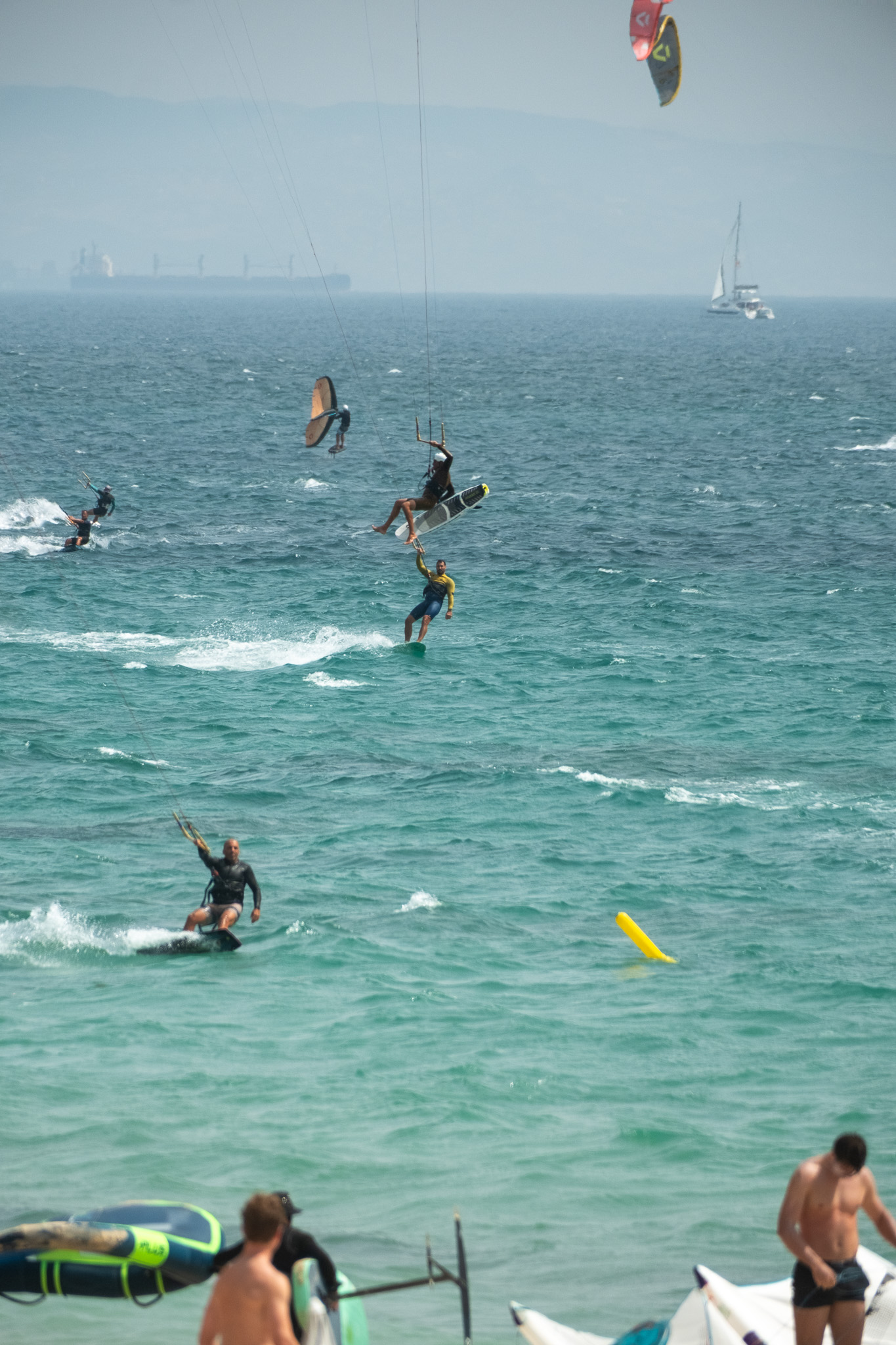
Learning kitesurfing on strong, windy summer days in Tarifa
You can absolutely learn on nuke-wind days, as long as your lesson is set up for it. Since high wind is our bread and butter, we're totally used to it. We'll set you up with a smaller kite and shorter lines tailored to your weight and experience. Shorter lines mean less pull and much easier control.
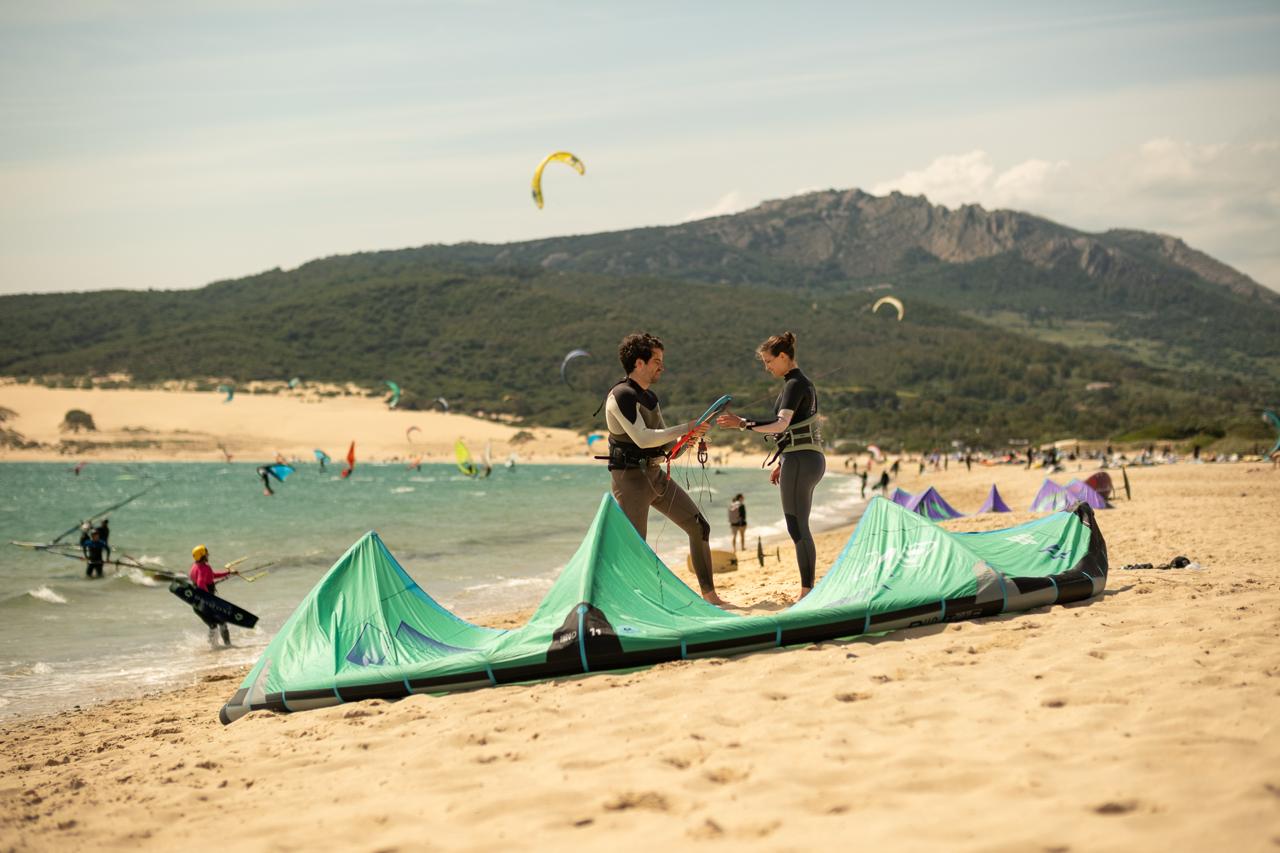
Normally, your first kitesurfing lesson starts on the sand, learning to fly the kite. But on strong Levante days, the kite pulls too hard for that, and there are people walking around. So we do our safety briefing on shore, hook up the lines together, and head straight into the water. Your instructor stays clipped right to you to help steer, and you'll wear a helmet with a radio so they can coach you step-by-step.
It's completely normal to feel nervous when you see wild wind. Our main job at the start is to help you relax and talk you through the game plan.
Our rescue boat is on active duty whenever the school is running, until late in the day in summer. If it ever gets too rough for the boat to run safely, we call off lessons. And if a day is just too extreme for your first time, we simply shift your lesson to a calmer slot.
Our guide to Levante and Poniente for kite lessons compares how each wind changes kite control, the water and the rescue boat.
Wingfoil on a strong windy day
On some strong Levante days, wingfoiling can be a better option than a kite lesson for a beginner. We won't throw you into crazy conditions—we'll grab a tiny wing, tweak the drills, or adjust the timing so you can actually enjoy it.
If you've never seen it, in wingfoil you hold an inflatable wing in your hands and stand on a board with a foil under it. The foil's like a fin with wings, and once you're going fast enough it lifts the board out of the water.
Your first wingfoil lesson starts on the sand. You'll pump up the wing, learn how to handle it, and get a feel for the wind direction. Then we grab a big, super-stable board and head into the water to practice taxiing on the surface. A small wing lets you get the hang of steering without flying up on the foil right away. You might ride 20 metres downwind, walk back up the beach, and try again. Your instructor stays right next to you, and hovering over the water comes once you've nailed the basics.
Strong Levante can bring flatter water, which makes standing up a lot easier. The trade-off is paddling back upwind takes effort. Whenever you need a breather, just sit back on your board. Your instructor will keep track of where you are and call the rescue boat over whenever you need a lift. And if the conditions aren't feeling right, we just hold out for a better breeze.
It's definitely a workout! Sofie booked a two-hour wingfoil session with us and split it across the afternoon. As she put it:
"I was dead after one hour."
Our guide to Levante and Poniente for wingfoil lessons explains which wind is easier for beginners, how much wind you need and how small waves change things.
How busy the water gets in August, and why it matters more for kite
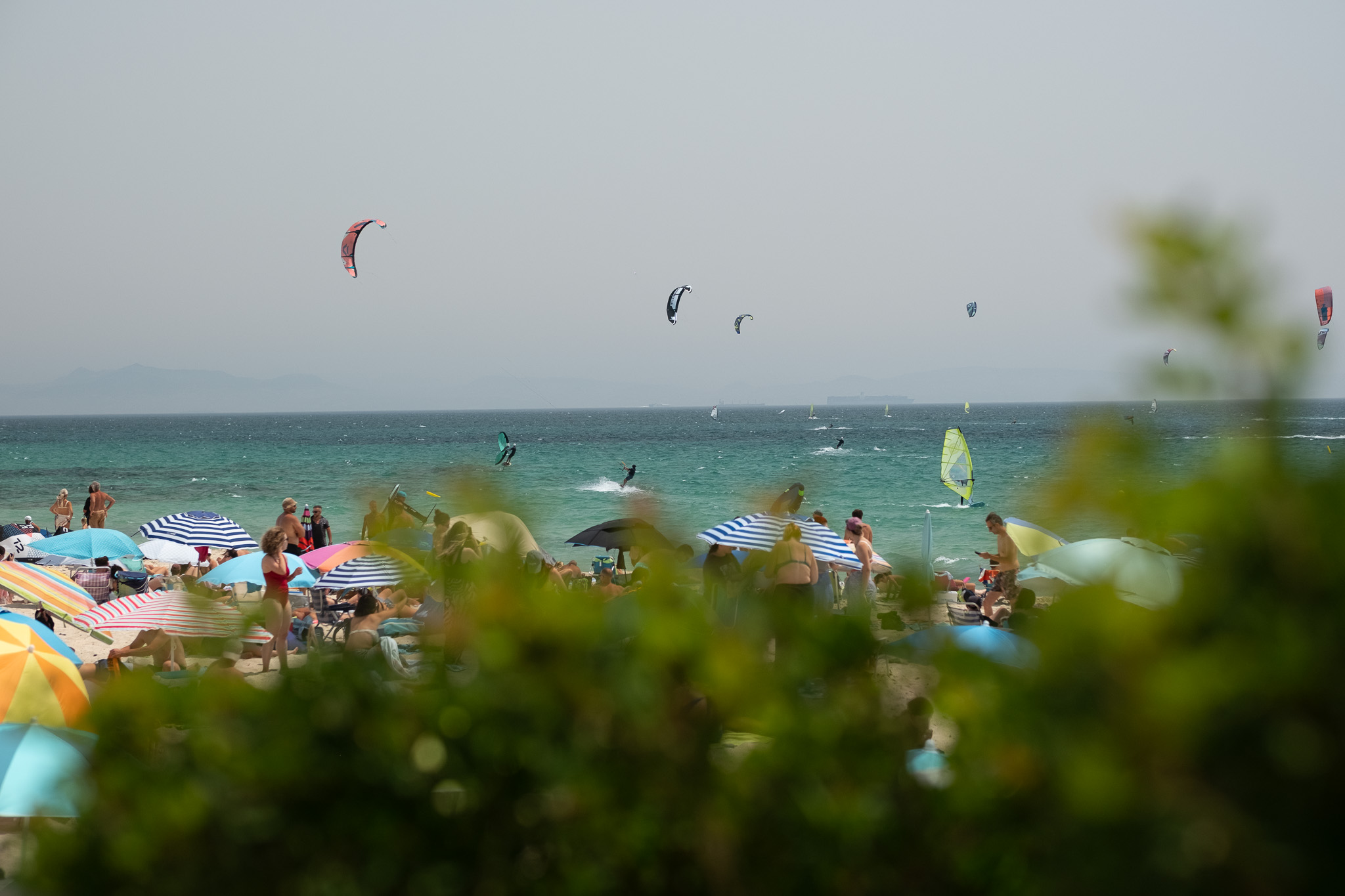
On a busy summer day, you might see 50 to 100 kites in the air around you. Come back in October, and it's more like 15.
The beach isn't very wide either, about 25 to 50 metres from the water to the fence of the nature reserve, and in July and August part of it is kept for swimmers. You can't kite on the beaches in town during these months, so more people come out here.
Kites take up a lot of real estate. You've got 20-metre lines stretching out, and even shorter lesson lines need plenty of clearance. When you're learning water starts, the kite drags you downwind along the shoreline. On crowded days, you have to stay super aware of everyone around you and wait for clear windows.
If you've ever watched a crowd of kites from the beach, you've probably wondered how lines don't get tangled all the time. Truth is, they can—especially with beginners. When you're new, you can't always control where the kite goes next, and other riders can't predict your moves either. It's a lot like driving near someone who forgot to use their turn signals!
That's why giving yourself space makes such a huge difference. It can be the factor between a stress-free lesson and a tough day. It's why we adapt our coaching style when it gets packed, and why wingfoiling is such a great summer alternative.
Our designated teaching zone is about 200 to 300 metres long, so you'll drift down, walk back up, and repeat. You definitely won't be out there alone—one rider who learned in Tarifa in August said they loved having other people learning around them.
Planning your lesson times in summer
When you book, our office team assigns your lesson times. In July and August, those schedules are pretty set because we're fully booked. If the wind acts up, we do everything we can to shuffle things around. Outside peak summer, we have way more wiggle room to match your lessons to the day's best wind forecast.
We run lessons all day long in summer. Matteo's ideal day starts at 8:15 AM—scoring a morning Levante session for himself until 10:15 AM, then hopping straight into his school gear to welcome students until the sun goes down.
What if the forecast calls for light wind? Don't panic—that usually means Poniente (our west wind), and forecasts can be deceiving. As the land warms up during the day, thermal effects kick in and boost the breeze. A forecast showing 10 knots in the morning can easily build into 20 knots by 2 PM. Check out our guide to reading Windguru to learn how to spot thermal wind trends.
On average, 75% of summer days have enough wind for kite or wing lessons. On a typical 7-day trip, you can expect about 5 days with enough wind—which is why staying a full week is such a smart move.
Kitesurf or wingfoil in August: why we often suggest the wing
If the idea of busy water stresses you out, give wingfoiling a shot. You hold the wing directly in your hands—no 20-metre lines—so you need way less personal space. It's super intuitive to pick up, and whenever you feel tired, you can just dump the power instantly by letting go of the wing.
That said, if kiteboarding is what you've been dreaming about, go for kiteboarding! Just keep in mind that on zero-wind days, neither sport works—if there's no breeze for a kite, there's usually not enough for a wing either.
Our kitesurfing vs wingfoiling guide explains what learning each one is like.
Private lessons in July and August: who should book one
We strongly recommend private lessons for kids, nervous beginners, or anyone uneasy about deep water or crowds. You get 100% of the instructor's attention. In semi-private lessons, you share an instructor with one other person and take turns with the kite. Check out our breakdown of private vs semi-private kite lessons to decide what fits you best.
Kids are lighter, so strong gusts affect them much more. On heavy Levante days, kite lessons aren't always safe or fun for younger children. Most kids start around 12 years old, but it really comes down to confidence and body weight. If they're a bit young or light for kiting, starting out with a tiny wing is an awesome alternative. Have a look at our guide on kitesurfing vs wingfoiling for kids for more details.
Only have three days in August? Consider wingfoil
Keep your expectations relaxed and treat it as a teaser experience. Losing one day to bad wind takes out a huge chunk of a 3-day getaway, and most people need more time to become independent riders anyway. If you can stretch your stay to a week, you'll have a much higher chance of hitting optimal conditions.
Late August: the beach starts to get quieter after the 20th
If you get to choose your week in August, target the dates after August 20th. It's still lively (Spanish school holidays run until mid-September), but the intense peak starts to ease off. Keep in mind that weekdays and weekends feel pretty similar in midsummer, so don't expect a super quiet Tuesday!
Booking July and August lessons: the sooner the better
Lock in your dates as soon as you know you're coming. Most people book two to three months in advance, and summer slots sell out fast. Matteo took a while to answer one of our questions last August, and his voice note started with a sorry:
"Because we are full August."
We do get walk-ins every day, and if you're already in town, we'll always try our best to squeeze you in. But last-minute slots mean fitting into whatever random gap is open. Booking ahead lets us match your age, weight, and skill level to the best wind conditions available.
If the wind's not good, we'll move your lesson to another day, offer you wingfoil or another activity, or give you your money back.
Be sure to reserve your stay and rental car early too. Since public transport doesn't go to Valdevaqueros, having your own wheels or taking taxis is essential. Parking can be crazy around Tarifa in summer, but our center has free, dedicated parking for our guests. Read our Tarifa trip planning guide for top tips on flights and accommodation.
What a summer trip to Tarifa costs
Summer is definitely peak season price-wise, but that's down to hotels and car rentals—not our school! Our lesson rates stay the same year-round. A 2-hour private lesson is €199 and a 6-hour package is €510. You can check all our current options on our prices page.
Accommodation and car rental prices peak in July and August—people vent about summer room rates on kite forums every year, and fair enough! Food and restaurants stay reasonable all year round. If you're on a budget, travel rates drop right after August, which makes September look even better.
Why we use a full wetsuit in August, even when it's hot
A full wetsuit keeps you safe from the sun and protects your legs from board bumps. Throughout July and August we use a 3/2 mm suit (3mm body, 2mm limbs). Gastón always recommends full suits over shorties, and promises that once you're in the water, you won't feel hot at all. Plus, we supply all wetsuits, so no need to pack one!
Pack plenty of sunscreen, good sunglasses, and a warm hoodie. One day the Levante feels super warm, and the next day a crisp Poniente blows in and you'll definitely want that jacket after your session!
Things to do in Tarifa on summer days with no wind
There's plenty of fun stuff to do when the wind drops. You can rent a stand-up paddleboard right from our center (€20/hr or €30/2hrs)—our guest Noor and her friends spent a whole no-wind day SUPing and hanging out at the beach bar next door.
You can take a whale watching boat tour out of Tarifa harbor (in high summer you might even see orcas), head 20 minutes down the road to Bolonia's massive sand dunes and Roman ruins, or grab your passport and catch the 1-hour ferry over to Tangier, Morocco. Or simply wander the old town streets and enjoy amazing tapas. Explore our guide to no-wind activities in Tarifa for more ideas.
Events and nights out in Tarifa in July and August
While major kite competitions don't usually run in midsummer, Tarifa is at its absolute liveliest. Long sunny days flow into packed chiringuitos, live sunset music, and vibrant night life in town.
Susan brought her kids for a kite course and highlighted the weekend DJ party at Bora (the beach bar right beside us) as an unforgettable highlight of their trip. If an event happens while you're here, you can watch top pros right from the sand! See our guide on events in Tarifa to check the calendar.
What to tell us when you book summer lessons
You don't need to know which lesson you want. Tell us:
-
Your age and weight.
-
Your dates, and how flexible they are.
-
Whether you want to try kitesurfing, wingfoil, or you're not sure.
-
Whether you've tried either sport before.
-
How you feel in deep water.
Let's set up the right lesson package for your trip
Tell us your dates, experience and whether you'd like to learn kitesurfing or wingfoiling. We'll help you choose the right lessons for your summer trip to Tarifa.
Prefer to talk? Call us at +34 681 286 516.
KEEP EXPLORING
Related guides for learning kitesurfing or wingfoiling in Tarifa
Choosing your dates
Best Time to Learn Kitesurfing in Tarifa: Month-by-Month Guide →
Compare wind, water temperatures, crowds and learning conditions from March to December.
Learning in September
Is September a Good Month to Learn Kitesurfing or Wingfoiling in Tarifa? →
Find out how September compares with peak summer for wind, beach crowds, lesson flexibility and travel costs.
Choosing your sport
Kitesurfing vs Wingfoiling: Which Should You Learn in Tarifa? →
Compare the learning experience, equipment, conditions and progression to decide which sport suits you.
Understanding the wind
Levante vs Poniente: What Each Wind Means for Kitesurfing Lessons →
Learn how Tarifa's two main winds affect kite control, water conditions and beginner lessons.
Choosing your lessons
Private vs Semi-Private Kitesurfing Lessons in Tarifa →
Understand the differences between lesson formats and which option works best for your experience and goals.
Planning your trip
Planning a Kitesurfing Trip to Tarifa: What You Need to Know →
Plan your flights, accommodation, transport and lesson days around the wind at Valdevaqueros.
Latest News
- Is November a Good Month to Learn Kitesurfing or Wingfoiling in Tarifa?
- Learning to Kitesurf or Wingfoil in Tarifa in Summer: What to Expect and What We Recommend
- When Should I Go to Tarifa to Learn Kitesurfing? A Month-by-Month Guide
- Levante vs Poniente for Wingfoil Lessons in Tarifa
- Levante vs Poniente for Kitesurf Lessons in Tarifa
- Is September a Good Month to Learn Kitesurfing or Wingfoiling in Tarifa?
- Am I Ready to Rent Kitesurfing Gear in Tarifa? (Or Do I Need More Lessons?)
- Wingfoiling for Kids in Tarifa: What Parents Should Know Before Booking
- Kitesurfing or Wingfoiling for Kids in Tarifa: Which Should They Try First?
- What Will You Learn in Wingfoil Lessons in Tarifa? From Day One to Independent Riding